


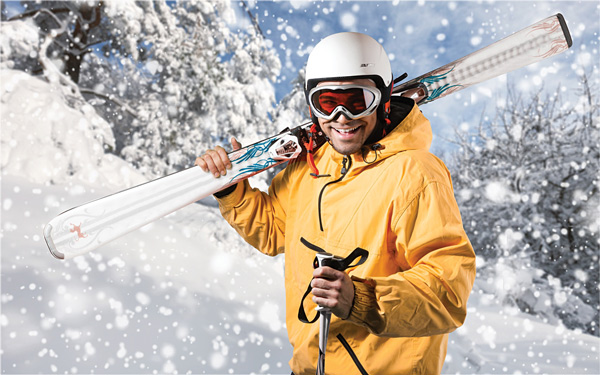
It’s 17 degrees F out and dumping. The snow’s been falling through the night and it’s going to be an epic day on the hill. Your body vibrates, your stomach flops. You need to get on the road soon or the traffic will thwart a perfectly amazing powder day. You brush off the foot of snow on the hood of your car and realize you have a problem — your roommate’s car is blocking yours.
Watch our video with Mountain Hardware
demonstrating how to put chains & cables on your car
You bang on the bedroom door pleading for him wake up and move his car. In the meantime, you collect your gear. You return to load the car only to watch in horror as your roommate pours a bucket of hot water on his windshield to melt the ice that formed overnight. A large cracking sound follows before you can say, “Don’t do that!”
MORE WINTER TIPS:
Read our “Tips for Tahoe Ski Trips”
Download the Mountain Safety Guide
Check out more tips for winter driving
Watch “Guide to International Ski Carrying”
These and more tales of ski season faux pas and antics are the delight and often butt of jokes in mountain ski towns. Whether it’s wearing a pair of jeans on the slopes, having a huge gap between the top of your helmet and goggles, unintentionally wearing your helmet backwards or sporting a goggle tan, I’d like to offer a few tips to get ready for ski season. If you already know this, please help to inform all of the newbies who have never lived in the mountains.
Get on the Mountain
The Pass | If you haven’t already, buy a ski pass. It really is the best deal you’ll find.
The Gear | Make sure you have the essential gear: ski jacket and ski pants or bib, base layers, helmet, goggles, skis, poles and boots. Boot warmers are a luxury, but one that will serve you well if you get cold feet.
Get Fit | Do lunges. Add in yoga poses such as chair pose and plank pose for balance and add in a few sit-ups, as well, to get into ski shape.
Get Pumped | Make sure to watch as many ski films as possible for inspiration. We’ve gathered more than 30 of the season’s ski trailers.
Be ready to ski | If you want to be extra ready to get to the mountain, leave your skis and poles in the car overnight, but bring your boots inside. It’s hard to get boots on when they are frozen. Stash your gear by the door — boots, helmet, jacket, pants and gloves.
Remember to make a mental checklist before you head to the mountain. There’s nothing worse than getting up the hill and realizing you left your boots home, or your ski pass.
Carrying Your Skis | Learn the basics, such as how to carry your skis. There is nothing worse than walking behind someone who turns around suddenly and nearly decapitates you with his or her skis.
There are numerous ways to carry skis, so which is the one that fits your style? We found the video “Guide to International Ski Carrying” from Teton Gravity Research to be both useful and funny.
The “Local” method is to carry both skis over your shoulder, tips in front and bindings behind your shoulder, arm rests on top of the skis. The “Reverse Local” method is to carry both skis over your shoulder, tips on the back, your shoulder in front or between the bindings, arm wrapped about the skis to fight the gravity forces of the skis.
Common Sense Dos & Don’ts
- SLOW DOWN and don’t tailgate. 4WD and snow tires or studs will not help you stop your car if it’s icy.
- Don’t use your high beams at night during a snowstorm.
- Never pour hot water on car windows. They will crack. Buy a cheap ice scraper and let your car warm up before heading out.
- Do ski with a buddy during a storm, even at a ski resort.
- Do keep jumper cables in your car.
- Do make sure you have supplies in your vehicle in the event you get stuck on the road in a storm. Keep a backpack or duffle bag in the trunk with extra clothes, jacket, boots, gloves, a blanket, protein bars or snacks, water and a first-aid kit. It’s always a good idea to have a shovel in your car in the event you get stuck or need to help a friend out.
- Do carry chains. Did you know it’s required to carry chains in your car during a snowstorm? Ever watch people spin out going uphill or careen down unable to stop? Chains can sometimes help two-wheel-drive cars on steep hills. We partnered with Mountain Hardware in Truckee to make a video on putting on chains and cables.
- Learn about winter driving. When driving downhill, drive slowly and downshift. If you rent a four-wheel-drive car, ask if the vehicle has snow tires that can get you out of a driveway after a snowstorm. Studded tires rock, by the way.


