


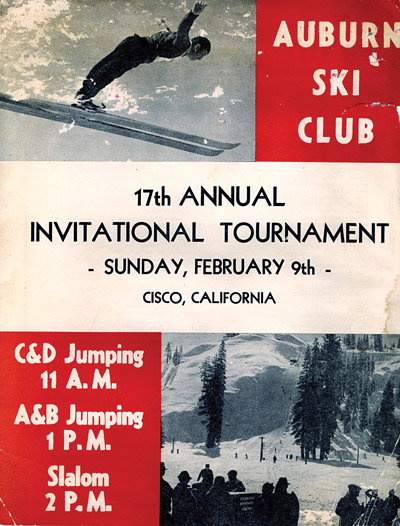
In 2018, Auburn Ski Club (ASC) will proudly celebrate 90 years of nurturing, training and educating skiers — both alpine and Nordic — and snowboarders in the Tahoe Sierra. The early decades of the 20th Century proved to be fertile ground for the growth and development of winter sports in California and ASC had a lot to do with it.
In the 1920s, Bert Cassidy, an avid skier and former owner of the Truckee Republican newspaper, moved to Auburn, a small foothill town on the Sierra Nevada west slope. He bought two newspapers there and in 1929 he was elected a state senator. From his prior experience promoting winter tourism in Truckee, Sen. Cassidy knew that snow-oriented activities boost cash flow in mountain communities when people can get there.
That was not a problem for the town of Truckee with its busy train depot located on the transcontinental railroad. In an editorial, Sen. Cassidy recounted how Truckee residents had pulled themselves out of an economic malaise in the 1890s by promoting winter sports. Cassidy wrote: “While skiing was available for the rugged outdoor sportsman, local businessmen soon united behind our winter sports program, because the popular sport brought visible returns in the form of a busy cash register. What appeared to be a dying town [Truckee] was soon one of the busiest beehives in winter economic life of eastern California. The sport was exhilarating.”
It’s probably safe to say that no California ski club has played such a major role in promoting winter sports, especially during the 1930s when skiing first captured the country’s imagination.
The next big stride in the development of California’s winter-sports economy came when ASC was organized in 1928. The club’s original mandate “to provide warm shelter, cleared slopes and the first engineered ski-jumping hill to be built in California” was met or exceeded. And it was through the group’s effort that California politicians were persuaded to support snow removal over trans-Sierra Highway 40. That legislation finally opened the Tahoe Sierra for the development of winter sports areas with thousands of visitors.
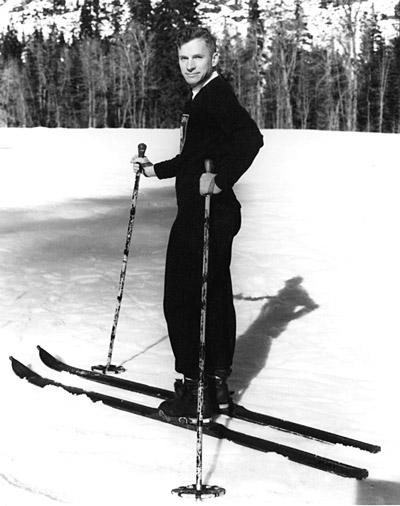
Right out of the gate it was apparent that Auburn Ski Club was going to be something special, a dynamo of energy and accomplishment that would soon propel it to the forefront of skiing in California and the West. Led by Wendell T. Robie, a no-nonsense businessman with a talent for organization and a passion for the outdoors, ASC moved forward in leaps and bounds. It’s probably safe to say that no California ski club has played such a major role in promoting winter sports, especially during the 1930s when skiing first captured the country’s imagination.
At that time, trans-Sierra automobile traffic stopped at the snowline, but skiers knew that deeper snow and greater coverage lay well beyond the closure point. Robie wrote how club members took it on themselves to clear part of the road: “Always, the road to higher snow pack areas for skiing were guarded by a solid barrier of deep drifts. It took youth, muscle, and hard work to clear the drifts to force open a lane of Highway 40 up to where the snowpack was continuous for skiing. The club had all this to do and their hard-shoveled road lane remained for several winters solely a skier’s road.”
After three arduous winters shoveling and sometimes blasting packed snow with dynamite, the members of Auburn Ski Club decided to take bold action. In early January 1931, they petitioned the California state legislature to fund snow-removal operations for high-elevation arterial highways, beginning with Highway 40. The club was convinced that winter travel by skiers and others would more than pay for the purchase of plows, equipment and personnel. ASC proposed a bill for the California Legislature to appropriate $685,000 for clearing Highway 40 first, with other highways to follow. The club had a powerful ally in Sen. Cassidy, who introduced the bill and helped move it forward to a vote.
Truckee had been accessible by railroad since 1868 and Tahoe City gained train service after 1900, but it wasn’t until 1931 that California resolved to keep the road over Donner Pass open throughout the winter. Before that, when deep snow closed the summit for the season, those wishing to cross by automobile paid Southern Pacific a fee to load their car onto specially designed railroad flatbeds that carried them over the mountains.
In Robie’s, “A Half Century of California Skiing,” he described how the club came up with an innovative solution to their No. 1 problem — car access to better snow conditions at the higher elevations. Robie wrote, “The Auburn Ski Club determined to sell this solution to the Legislature, and with the aid and counsel of Senator Bert Cassidy, an active member of the club, a bill was presented for the Legislature. Most of these men had never been in snow, while only a handful had ever been in the mountains in winter.” With only a few lawmakers experienced in snow for fun and sport, there was little motivation to appropriate the money. It seemed a dead issue and the date for action on the bill approached with little favorable response from the legislators.
ASC leaders realized that legislative approval of snow management on mountain highways was critical to California’s ski industry development. Some form of direct action was needed. The club determined to secure votes by persuading the legislature that the plan made political and economic sense. Representing ASC, Senator Cassidy extended an invitation to the whole legislature to be guests of the club at their winter sports grounds in the mountains near Cisco. The proposal was unusual, but the invitation was widely accepted.
On Sunday, Jan. 18, 1931, a caravan of 56 automobiles left Auburn for Sacramento where they picked up the legislators with their wives and families. When the convoy arrived at ASC’s winter grounds at Cisco, the guests were entranced by the wintry alpine landscape and thrilled by ski jumpers soaring in the sky. Despite federal prohibition, alcoholic refreshments were poured by members of the fraternal organization E. Clampus Vitus.
Soon 2,400 more cars arrived with skiers and spectators anxious to see the heavily publicized ski-jumping event. The resulting traffic jam convinced the legislators that gasoline taxes would more than pay for snow plowing and the bill was passed the following day. From that came the 1930s explosion of snow play areas and rope-tow ski operations from Rainbow Tavern to Donner Pass. But Robie and Auburn Ski Club still had more tricks up their sleeve in their effort to promote California winter sports. Stay tuned for Part II in the next edition of Tahoe Weekly and at TheTahoeWeekly.com.


