


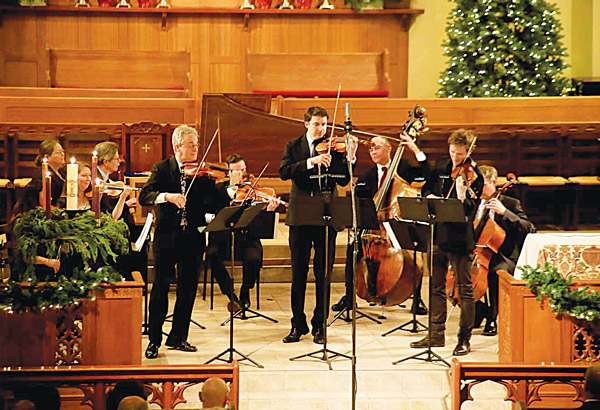
If you aren’t a classical music buff, you may be wondering: What is chamber music anyway? Fortunately, Reno Chamber Orchestra executive director Chris Morrison can explain.
Nevada Chamber Music Festival | Dec. 27-Jan. 1, 2018 | Reno, Nev.
“For people who haven’t had experience firsthand and are vaguely aware of chamber music, it is often perceived as being different or more specialized,” he says. “But the truth is if you come to any of our festival concerts, you’ll see what it’s like to sit merely feet away from world-class musicians. It’s a very special sort of experience. Once people get a taste of it they want more.”
“It’s all about being so close to each other. You can practically hear the musicians breathing and watch them interact with each other.”
–Chris Morrison
What makes chamber music unique is its intimacy. Whereas the Reno Philharmonic features 80 to 100 musicians and the Reno Chamber Orchestra averages 30 to 40, chamber ensembles are groups that typically range from two to eight players at the most.
WATCH: Beethoven’s Finale at the Nevada Chamber Festival:
“It’s all about being so close to each other,” says Morrison. “You can practically hear the musicians breathing and watch them interact with each other.”
In addition to well-known symphonies and other large-scale works for full orchestra, classical composers have been writing chamber music for centuries.
“Back when this started, centuries ago, there wasn’t all that much in way of public concerts,” says Morrison. “Most of the music was written for in-home performance. People would buy the sheet music and play it for their friends and family. Over the years, public concerts became more popular and now they are relatively commonplace.”
Reno Chamber Orchestra’s music director and conductor Theodore Kuchar started the festival in 2004 based on the Australian Festival of Chamber Music, which he also founded a quarter century ago.
“I believe that’s now the biggest chamber music festival in the Southern Hemisphere,” says Morrison. “When we started our version, we didn’t know what to expect. Maestro Kuchar had the idea to do the festival between Christmas and New Year’s because classical musicians are often available at that time and it worked. Over the years, we’ve gotten more attention, more acclaim and more musicians from around the world who want to come play chamber music in Reno for a few days.”
The festival takes place over the course of six days at locations around Reno. For the second year in a row, the festival will open with a performance of “Bach by Candlelight” at Trinity Episcopal Church on Dec. 27.
“We play nothing but the music of Johann Sebastian Bach almost literally to solely candlelight,” says Morrison. “There is only a little supplemental light for musicians. We try to make it as atmospheric as we can. It proved so popular last year that we’ve added a second performance.”
The festival will conclude on New Year’s Day with a champagne brunch and an all-Mozart concert at the same location. Other concerts throughout the week will feature the compositions of Beethoven, Brahms and Bartok, as well as sonatas by Rachmaninov and Richard Strauss.
“It’s a fascinating and mysterious thing,” says Kuchar. “There are certain musicians that even 200 or 300 years later still resonate with us; 267 years after his death Bach’s music in as popular as ever. He wrote over 1,100 pieces and his music is still about as challenging as it gets for certain instruments. It’s musically satisfying with a high level of difficulty to perform. It’s really colorful and intricate. Bach wrote music for church settings so he understood how sound in a cathedral works.”
Musicians from around the globe including violinist and Czech Philharmonic concertmaster Josef Špaček and Turkish flutist Bülent Evcil will travel to Reno to join the special event.
“Mr. Evcil is flying in from Istanbul and then headed to Italy to play right away afterwards,” says Morrison. “We pay the musicians the best we can, but it’s really not much for the amount of work they do. Most of them are here for the entire six days of the festival with rehearsals and concerts all day long. But the vibe around the festival is really positive. The audience is enthusiastic and the musicians love the people they get to work with. It’s an opportunity to see colleagues they don’t get to see throughout the year. We’re grateful that they continue to make the journey and put Reno on the map for classical music.”
For more information, a schedule of festival events or to purchase tickets, visit renochamberorchestra.org.


