


The winter of 1937-38 pummeled the Tahoe Sierra with heavy snow 80 years ago, but just like last season’s record precipitation, the weathermen never saw it coming. Similar to 2016-17, the winter of 1938 started off with a mild, wet weather pattern that left little snow in the mountains. But even the overwhelming snowfall that buried our region in January 2017 was exceeded in 1938 when a barrage of intense, cold storms dumped nearly 29 feet of snow in 14 days. The grand total of 819 inches of snow – more than 68 feet – measured near Donner Pass that year is still the greatest seasonal snowfall on record since 1879.
Read: Part I. Here.
On Feb. 14, 1938, the snow depth at Southern Pacific’s Norden Station at Donner Pass towered nearly 20 feet. Railroad traffic was stalled throughout the Sierra. Even Southern Pacific’s newly acquired $2 million train, “City of San Francisco,” was delayed by the derailment of a rotary snowplow that hit a tree buried in a snow slide. Just six weeks after its inaugural run, the train billed as the “largest, fastest, most beautiful, powerful and luxurious streamliner ever designed,” was stalled for nearly a day near Donner Pass. The passengers got off easy this time. In January 1952, the “City of San Francisco” would be snowbound by a major storm west of Donner Pass and its desperate passengers were not evacuated for several days.
Over the course of 14 days in February 1938, Donner Pass was hit with a phenomenal 341 inches of snow — 28.5 feet — an average of about 1 inch per hour nonstop
for two weeks.
Over the course of 14 days in February 1938, Donner Pass was hit with a phenomenal 341 inches of snow — 28.5 feet — an average of about 1 inch per hour nonstop for two weeks. The massive storm dumped more than 17 feet on Truckee during the same time frame. The overwhelming snowfall isolated communities throughout the region. The main highway from Reno, Nev., to Quincy was blocked for days by snow slides. To make matters worse, an avalanche wiped out transmission lines and cut off all power and communication to the small mountain town.
The town of Portola in northeastern California had 6 feet of snow on the ground. For nearly a week the town had no electricity or telephone service. The mining community of La Porte was arguably in the worst shape; their local saloons had run out of liquor. The recently built Feather River Highway, celebrated as a beautiful all-weather alternative route over the Sierra, was closed for 30 days due to rock and mud slides.
Nevada also had its share of problems. There was so much snow in Reno that hundreds of truckloads of the stuff were being dumped into a large vacant lot next to the Truckee River. Sierra Pacific Power Company hired 300 men to break up ice flows that were damaging dams and power generation equipment on the Truckee River. The heavy snowfall was too much for the 14 snowplows in operation in the vicinity and even the main highway to Carson City, Nev., was closed for several days. There was no news from California for eight days due to downed telephone lines.
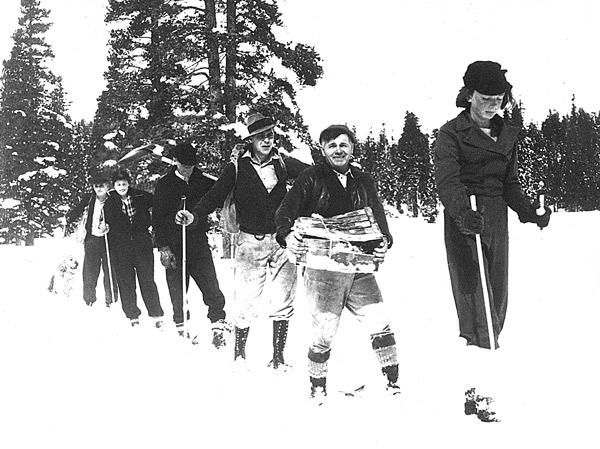
On Feb. 16, the relentless storm finally moved east, giving way to clear skies and cold temperatures. Tahoe City’s residents had survived 17 feet of new snow in 16 days, but they were still in a tight spot. The main roads were buried under snow 12 feet deep with drifts approaching 20 feet. There had been no mail deliveries to Tahoe City for a week and no fresh food for twice that long. Most households were completely out of butter, eggs, coffee, bread, milk, fruit and vegetables. Supplies of canned food were running low. No one was starving yet, but several families with young children were worried as their pantries emptied.
On Feb. 19, with all roads impassable and the highway department’s rotary snowplow still at least two days away, pioneer Tahoe City businessman Carl “Pop” Bechdolt Sr. used the last remaining telephone wire to communicate with the outside world. He contacted California’s governor about the dire situation and was promised immediate action to get food into the area.
Over the next 48 hours, airdrops for Lake Tahoe communities were organized in the San Francisco area with supplies provided by the Red Cross. On Feb. 22, Tahoe City residents built signal fires in the middle of the town’s snow-covered golf course and that evening an airplane was heard circling above. The pilot brought the plane in low, about 400 feet above the bonfires.
No one could see the aircraft, but for a few minutes they heard the drone of its motors. A few minutes later, the hum of engines faded into the distance as the plane headed back over the mountains. In the darkness, no one had seen any supplies dropped — no one except Charlie Swanson who was nearly killed by a plummeting box of food as he stood under a tall pine tree. He was saved when the wooden crate of fresh vegetables shattered against the thick branches and showered carrots and potatoes into the snow around him.
Residents were told that there would be 10 boxes of food dropped, but despite an extensive search that night by men and women on skis and snowshoes, just two boxes of meat were located. The following morning, they had better luck and were able to dig up all but one of the missing crates of provisions. All the boxes were broken, but the contents remained undamaged and edible. A portion of the food went to Tahoe City families and the remainder was delivered to other North Shore communities by outboard motorboat.
On Feb. 21, a rotary snowplow that had been slowly churning its way from Truckee for seven days finally roared into Tahoe City, opening a one-way road between the two communities for only the second time in a month. Close behind the plow followed a truck loaded with the U.S. mail, its first appearance in 12 days.
There were more than 20 mountain fatalities that winter from avalanches and exposure, but spring was worse with hundreds more dying in the catastrophic flooding that swept much of the Golden State as the snowpack melted. The winter of 1938 started late, but powerful storms in February managed to produce epic snowfall to set a new record.


