


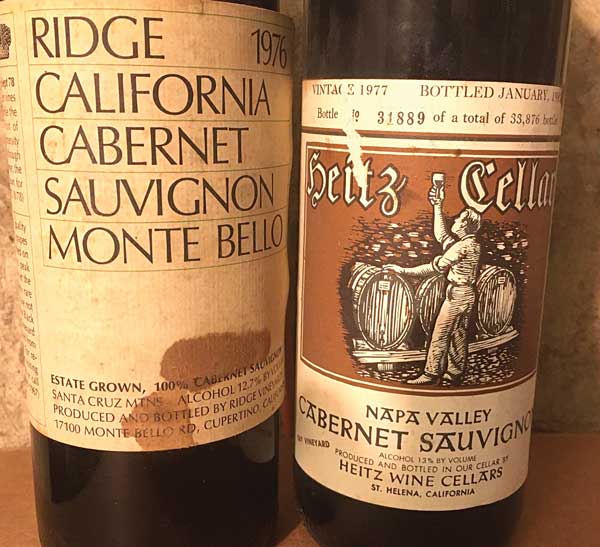
When we last left our protagonists/heroes, aka Napa Valley’s finest, it was 1976 and they had just kicked the collective fannies of the defending wine champions: red Bordeaux and white Burgundy.
It was a new dawn on a new day and a closer to even playing field for not only California wines, but also those from regions other than France.
To review, the event was “The Judgement of Paris,” and almost all of the judges were the crème de la crème of French wine experts. The fact that this group of adamant California wine haters had judged Napa as king in a blind tasting was clearly “the shot heard ‘round the world.” America stood toe-to-toe and scored a decisive TKO. Restaurants, collectors and even wine critics had to change their tunes and their reviews of these revelatory wines.
Read Parts I & II at TheTahoeWeekly.com
It was a new dawn on a new day and a closer to even playing field for not only California wines, but also those from regions other than France.
You see it was not just the United States that was getting the short end of the stick from the wine reviewers who were the absolute taste makers of the day, it was all producers outside of France. The why of this is easy to see because the writers, importers/exporters, distributors and restauranteurs were being incentivized by French wine producers and promoters to communicate that the only truly great wines were French. This was possible because wines were rarely tasted using scientific blind tasting/testing. Also, when you look at the reviews of the day, you see they were filled with non-specific terms such as class and breeding and written in a way that inferred that one would be an oaf to not perceive the superiority of les vins du France. Any wine critic who dared express an alternative opinion was writing his or her own termination papers.
The Judgement of Paris did not change opinions that immediately, but it did start a wave that swelled into a tsunami of objective reviewers, restauranteurs, collectors and, most importantly, any media persons that tasted blind and reported those results.
This created an environment that allowed for the rise of Robert Parker, whom I shall feature in my column soon. For now, the short story is that he refused to be incentivized and he boldly proclaimed his analysis even if he was the lone voice for that position. He also popularized the now ubiquitous 100-point wine-rating system; others had point or star systems from 1 to 5 or 1 to 20. Those systems created large scoring gaps that allowed for significant wiggle room.
The 1976 Judgement of Paris is arguably the most important single event in wine history. It transformed the corrupt world of wine reviewing into a reasonably fair system where even a wine from the wrong side of the tracks could get a fair shake. It is indeed truth, justice and the American way.


