


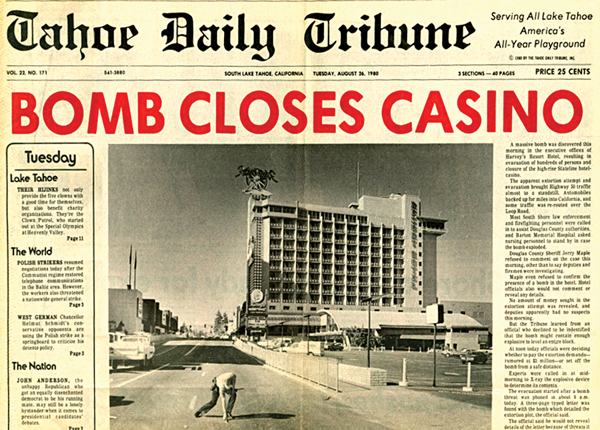
In late August 1980, an angry gambler attempted to extort millions of dollars from Harvey’s Hotel Resort by threatening to blow up its hotel casino at South Lake Tahoe. John Birges Sr. was bitter that he had lost $800,000 playing blackjack and he wanted it all back — plus more. So, he built a powerful bomb with nearly 1,000 pounds of dynamite to pull off the $3-million shakedown.
On the morning of Aug. 25, Birges and two accomplices, Willis Brown and Terry Lee Hall, checked into Balahoe Motel near Lake Tahoe Airport. As the owner of a motel, Nancy De Minico had a sixth sense for sketchy guests, so she wrote down the license number of the white van in which the men drove up. That information would become an important clue for law enforcement to track the vehicle registration to the house of Birges’ son, John Jr. Yet it would still take a year to capture the mastermind behind the crime.
During all this time, a bomb with eight sensitive detonators connected to nearly 1,000 pounds of high-explosive dynamite, was sitting in the back of the van.
After a few hours of fitful sleep in the motel, in the early morning hours of Aug. 26 Birges walked to a public pay phone near the airport. In fact, he was hiding instructions for the ransom drop-off. He told Brown and Hall to carefully clean the room, remove any fingerprints and then drive to the airport to pick him up. Birges waited, but the transport never arrived. He walked back to the motel where his co-conspirators were unsuccessfully trying to start the van. The battery was dead so they called a tow truck to jump-start the vehicle. During all this time, a bomb with eight sensitive detonators connected to nearly 1,000 pounds of high-explosive dynamite, was sitting in the back of the van.
Read Part I of Mark’s three-part series.
In pre-dawn darkness, the men drove to the casino district and parked across the street from Harvey’s where they unloaded what they called the machine onto a customized wheeled cart. The cart carrying the bomb was rolled across the street to Harvey’s front lobby entrance. Birges concealed it with cloth displaying an IBM logo. To the casual eye, it looked like a standard paper-copying machine.
Birges had welded caster wheels to the bomb’s base so at the street curb Hall and Brown were able to push it flush onto the sidewalk and roll it into the casino. From there, Hall muscled it into a service elevator and took it to the second floor.
Birges showed up and the men positioned the bomb in a quiet corridor near the casino’s business offices. Birges used toothpicks and glue to disable the locks of the doors at either end of the hallway so no one might accidently set off the deadly device. After leaving an extortion note next to the machine, Birges, Hall and Brown drove back to Fresno County where Birges contacted his sons John Jr. and James. Birges’s girlfriend, Ella Joan Williams, was in on the caper, as well. Birges told them he needed their help at Lake Tahoe to collect the ransom money. According to plan, that afternoon the six co-conspirators headed out on a mission to get the money.
Birges’s ransom note was discovered at 6 a.m. on Aug. 26 by a Harvey’s slot manager, who noticed the sealed doors and tampered locks. Security was called and once they opened the hallway doors and read the contents of the envelope, they learned of Birges’s threat.
The extortion note warned of the extreme sensitivity of the detonators in the bomb stating that it would go off at the slightest vibration or movement. The anonymous creator of the apparatus cautioned: “Do not move or tilt this bomb, because the mechanism controlling the detonators in it will set it off at a movement of less than .01 of the open end Ricter (sic) scale. Don’t try to flood or gas the bomb. There is a float switch and an atmospheric pressure switch. Both are attached to detonators.”
The ominous warnings indicated the complexity of this massive bomb. It could not be taken apart without triggering the weapon. The letter forewarned that even turning the flathead screws in the metal boxes would cause it to blow. Authorities were in a tough spot and they knew it. Without guidance from the evil genius who built the device, there was no way to render it safe.
For the critical information needed to defuse the bomb, the ransom letter demanded $3 million in “unmarked, unbugged and chemically untreated $100 bills.” The untraceable cash was to be delivered to a specified site by helicopter that night — not much time. Directives would be hidden at public phone booths or delivered by an unaware taxi driver or individual — but not by the bombmaker.
Harvey’s chief of security was called as was Douglas County Sheriff’s Office and Tahoe-Douglas Fire Protection District. On discovery and confirmation that the bomb was real by using a specialized X-ray machine, police immediately evacuated an estimated 600 employees and patrons from the hotel casino. Several blocks of streets and businesses were closed and cordoned off. Scores of explosive specialists arrived from the military, FBI and other federal agencies, but all were stumped on how to disarm the expertly constructed bomb. It was the most sophisticated apparatus that they had ever seen.
At this point, what had begun as a calculated and technically impressive criminal operation worthy of a James Bond movie script, quickly took on the farcical incompetence of a Keystone Kops comedy. The delivery of the ransom money via helicopter was botched due to sloppy instructions and an overly elaborate plan concocted by Birges. He dispatched his girlfriend to drive to an airport near Placerville and wait for the helicopter to land there. Birges planned to be in the chopper because he intended to hijack it that night when it showed up to deliver the ransom money near Lake Tahoe. Meanwhile Birges and his two sons drove up Highway 50 to Ice House Road, the planned rendezvous point for the money handoff. They intended to signal the helicopter with a strobe light, but neglected to bring the battery for it. They tried to steal a battery from a Volkswagen parked outside a closed service station at Kyburz, but were chased away by the owner of the garage.
The Birges family then drove west, down the mountain to Placerville where they purchased a car battery from a Shell gasoline station, before returning to the Ice House Road location. Armed with three loaded guns, Birges and his sons split up to wait for the helicopter. The trap was set — or so they thought.
Stay tuned for the conclusion in the next edition and at TheTahoeWeekly.com.


