


Editor’s Note: Check in advance for current operating schedules before visiting.
Portola, Calif., reminds me of Truckee when I first moved there in the late 1970s. A bit worn and scruffy around the edges perhaps, but filled with friendly and welcoming people. And like Truckee today, Portola has an active railroad, the Union Pacific, and a pristine mountain river running through it. This placid upper stretch of the Middle Fork of the Feather River is complemented by a paved pedestrian and bicycle pathway alongside it.
Read Mark’s two-part story on mountain man James Beckwourth
Getting to Portola is nearly as enjoyable as it is exploring the town and its environs. There are a variety of options for this drive depending on your starting point, but my favorite route from Truckee is to follow Highway 89 north until you reach the crossroads hamlet of Sattley. Then take scenic A23 to Highway 70 just east of Portola. I prefer taking A23 up and back, but if you have the time and desire you can drive west from Portola on Highway 70 until you reach Highway 89 again and head south back toward Truckee.

The A23 is a scenic route through expansive Sierra Valley, headwaters of the Middle Fork of the Feather River. This beautiful basin rimmed by mountains and laced with streams is lush with flora and herbage that provides grazing land for livestock and ranching. The abundant water and broad meadows also make this area an important stop for migrating birds flying the Pacific Flyway along the eastern Sierra Nevada. Among its many remarkable qualities, Sierra Valley is the largest valley in North America above 5,000 feet in elevation. This elevated plateau was once home to Washo Indians, the tribe that considers Lake Tahoe the birthplace of the Washo People. Nearby, Maidu Indians hunted and fished along the Feather River heading west.
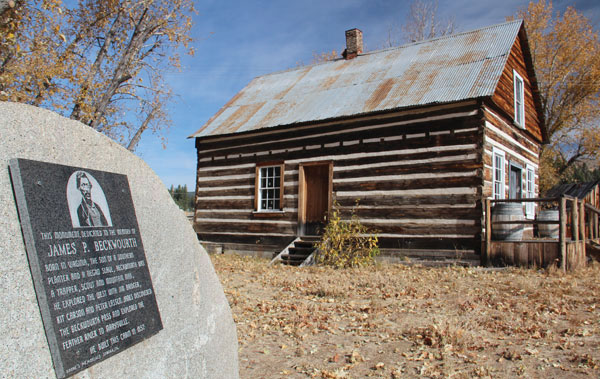
When you reach Highway 70 (east-west) visit a well-preserved 1850s log cabin built by the legendary fur trapper, scout and mountain man James Pierson Beckwourth. Born into slavery, the son of an African American mother and white slaveowner father, Beckworth enjoyed a remarkable life. Among his many accomplishments, in 1850 he discovered nearby Beckwourth Pass, the lowest elevation passage in all the Sierra range. Among the first wagons he led into California in 1851 was 10-year-old Josephine D. Smith, a niece of murdered Mormon prophet Joseph Smith. Riding in the saddle with Beckwourth she became the first white girl to cross Beckwourth Pass. Josephine later took the name Ina Donna Coolbrith and became the Golden State’s first Poet Laureate.
Jim Beckwourth Museum (530) 283-6320, ci.portola.ca.us
Western Pacific Railroad Museum (530) 832-4131, wplives.org
Williams House Museum (530) 832-0671, ci.portola.ca.us
Beckwourth is the only African American frontiersman to record his life story — published as a book in 1856 as “The Life and Adventures of James P. Beckwourth.” He constructed this cabin in 1852 as a trading post for gold seekers and emigrant wagon trains heading west. Today it houses the James Beckwourth Museum and is located east of Portola.
Drive west on Highway 70 for the neighborly community of Portola. As you descend the hill into town look for the Williams House Museum on your left. The building serves dual purposes; it is the Portola Visitor Center — a good place to get your bearings — and the original 1931 homestead of the Williams family, a legacy from Sam and Ethel Williams who arrived during the Great Depression looking for work. They opened a gas station and car dealership here and lived in the back. Over the years they closed their businesses and put a large log home on the property. Today, the Williams House Museum offers a portal into the early history of Portola including photographs and artifacts. Examine the stone fireplace where the rocks contain sparkling crystals and quartz. The friendly staff are volunteers from the Portola Area Historical Society and love to share stories and information about the region. Pick up a brochure and ask about local restaurants or tours and find out what is open during your visit.
The city of Portola stretches along both sides of the Feather River. There are homes, businesses and river access along the main drag Highway 70. The south side of the river — reached by the Gulling Street bridge in the middle of town — houses government buildings, restaurants and shops. The district is small enough to walk around but bring a bicycle if you can because opportunities abound for cycling tours. To visit this city’s most popular tourist attraction, make the first right over the bridge on Commercial Street, the heart of downtown Portola. Follow the signs to Pacific Street, where you make a gentle left turn, followed by a right turn onto Western Pacific Way. You have arrived at the Western Pacific Railroad Museum, known as the Portola Railroad Museum, a beloved institution for aficionados as well as families and anyone intrigued by trains and the evolution of railroad technology.

Spread over 37 acres, the museum owns more than 120 pieces of historic railroad rolling stock and 36 engines, including a mammoth Union Pacific 6946, the largest diesel locomotive ever built. A large open warehouse hosts a 16,000-square-foot working diesel shop that features an exhibit room while a plethora of railroad-related displays are located throughout the cavernous space. Visitors are always pleased to learn that the WPRM is a hands-on facility, where everyone is encouraged to climb into old passenger coaches or cabs of locomotives – including the UP6946.
WPRM is a paid admission facility that runs delightful caboose rides during summer weekends. As of press times, plans were to reopen the museum to the public on July 1. The museum is also home to the world-famous “Run A Locomotive” program where wanna-be engineers can pony up to operate and drive one of the vintage diesel engines guided by a private instructor. The sprawling yard is adjacent to the active Union Pacific mainline, which follows the deep Feather River Canyon into and out of California. The rumbling vibrations and piercing whistles of passing freight and passenger trains truly animate the railroad vibe of this museum.
The surrounding Plumas National Forest is a recreational wonderland with many natural features that are worth exploring as well including nearby Lake Davis Recreation Area and hiking and mountain biking trails spread throughout the Lost Sierra. | www.ci.portola.ca.us, easternplumaschamber.com


