


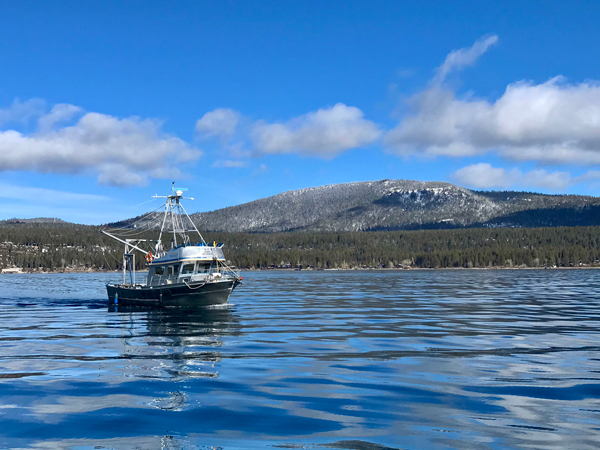
Courtesy UC Davis News and Media Relations/TRPA
Lake Tahoe’s water clarity measurements, which are indicators of the health of the watershed, averaged 62.9 feet through 2020, the UC Davis Tahoe Environmental Research Center and the Tahoe Regional Planning Agency announced on July 8 in a press release.
Average clarity in 2020 was 63 feet, which is just slightly better than the 2019 average of 62.7 feet. Lake Tahoe’s clarity peaked in February 2020 when it was deeper than 80 feet. It was at its lowest in mid-May when it measured at slightly more than 50 feet. These readings were within the average range of the last decade.
Clarity has been measured by UC Davis researchers since the 1960s as the depth to which a 10-inch white disk, called a Secchi disk, remains visible when lowered through the water. Because lake clarity measurements vary from day to day and year to year, managers and scientists remain focused on long-term trends as an indicator of the lake’s health.
In 2020, UC Davis scientists took 27 individual readings at Lake Tahoe’s long-term index station. Using technology beyond the Secchi disk, researchers continue to refine their understanding of lake physics and ecology to determine the evolving causes of clarity change.
Measurements show Lake Tahoe’s annual clarity has plateaued over the past 20 years. Despite this progress, summer clarity continues to decline by over a half-foot per year.
“While there is a good understanding of how fine clay particles and tiny algal cells reduce clarity, the biggest challenges are in reducing their presence in the surface water,” said Geoffrey Schladow, director of the UC Davis Tahoe Environmental Research Center. “Here climate change, and in particular the warming of the surface water, is exerting an undue influence.”
A recent review of clarity data by the Tahoe Science Advisory Council reaffirmed the understanding of main drivers of clarity loss, which concluded that fine sediment particles and algae continue to be the dominant variables affecting Tahoe’s clarity.
Past UC Davis research and the council’s report has also pointed to climate change altering precipitation and snowmelt patterns and increasing the temperature of the lake and impeding deep lake mixing. | Full report tahoe.ucdavis.edu


