


After a year of being closed due to the pandemic, UC Davis’ Tahoe Science Center in Incline Village, Nev., has reopened with new exhibits and in-person tours.
Learn why Lake Tahoe is blue
Watch a virtual tour of the Tahoe Science Center
Courtesy TERC
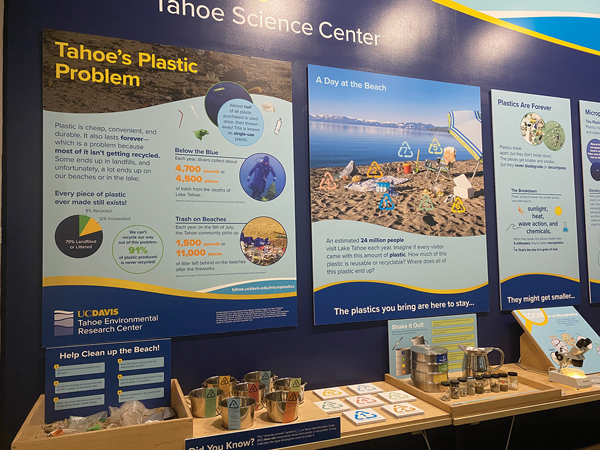
The center is run by UC Davis Tahoe Environmental Research Center (TERC). Volunteer docents were excited to showcase its new microplastics exhibit, Tahoe’s Plastic Problem, as well as continue its mission of educating visitors and locals on science and all things Lake Tahoe.
“A lot of information comes out of this tour that even people who are very familiar with Tahoe didn’t know before … people are surprised to learn that the sediment at the bottom of Lake Tahoe is probably as deep as the water.” –Robert Southern
On a Tuesday afternoon in early July, I joined six other people on a 4 p.m. tour. A couple in their mid-20s came up from Reno, Nev., and a family with two young boys drove over from Carnelian Bay for the hour-long tour. According to our volunteer docent Robert Southern, people from all over the U.S. have been visiting the museum since its reopening.
Public Tours
Tues.-Sat. | 3 tours daily
By advance reservation
“People come in who’ve been here before and they want to bring their guests,” says Anne Graham, who is working with TERC on a temporary AmeriCorps internship.
“A lot of information comes out of this tour that even people who are very familiar with Tahoe didn’t know before,” Southern adds. “For instance, a lot of people are surprised to learn that the sediment at the bottom of Lake Tahoe is probably as deep as the water, all the way down to its bedrock.”

It’s clear that both Graham and Southern are passionate about Lake Tahoe and are eager to share the important work that TERC scientists do to preserve the lake’s natural state.
The tour is interactive and fun; it covers topics such as how the lake was formed, what TERC scientists do to measure its clarity, the importance of its watershed and the natural (or unnatural) fish and other aquatic species found in the lake.

TERC opened on the campus of Sierra Nevada University and started giving tours in 2006. It maintains permanent installations such as the gigantic watershed map on a wall at the entrance, a life-size 3-D example of a research vessel that scientists regularly take out on the lake and a lab space with a few fish tanks to show the different types of species in Tahoe. Newer and rotating exhibits include the microplastics installation that shows examples of cutting-edge research relevant to what is happening with Lake Tahoe today, as well as what people can do to combat the problem.
The tour started out with Southern explaining the area’s watershed, which is almost as big as the lake itself, and shared how the lake was formed. Spoiler alert: It was formed by earthquakes, volcanoes and glaciers.
Next, the group migrated over to the Virtual Research Boat exhibit, a life-size version of the UC Davis research vessel “John LeConte” with the tools scientists use to measure the lake’s clarity. In 1968, a Secchi disk lowered below the water’s surface could be seen 100 feet down, but smaller particles like hydrocarbons, silts and clays continuously entering the water today have cut visibility to only 63’ in 2020, according to a recent report from TERC.
We walked by a wall of photos showing the depictions of ongoing research since its inception and entered the aquarium exhibits where a 5-year-old Lahontan trout named Lonnie happily swims. Facing Lonnie, a baby Lahontan, has a tank all to itself. This exhibit also supports the TERC Trout in the Classroom program, where students learn about the lifecycles of a fish and are involved in raising the trout eggs.
In our public tour, Southern showed pictures of Tahoe’s food webs, real examples of the destructive invasive Quagga mussels and what is being done to keep algae from spreading in the lake.
However, it was the Shaping Watersheds Interactive Sandbox that was the hit of the tour with the boys. It shows undulations in the mountains and uses a blue lighting effect to fill up the crevices with water. As the rest of the tour watched a video in the 3D Visualization Theater about the history and current state of Lake Tahoe, the kids were having a heyday with the sandbox. Their father had to tear one of them away from it.
Overall, the tour was informative and interesting and the volunteer docents each brought a little something different to each tour. | tahoe.ucdavis.edu


