


In 1863, Joseph Gray erected a toll station along the Truckee River to serve wagon and freight traffic on the Dutch Flat/Donner Lake Wagon Road that was under construction at the time. The turnpike was being built to glean profits from the heavy traffic between California and the booming silver mines near Virginia City in Nevada Territory. Gray and his family opened a frontier rest stop and way station for weary travelers traveling the rough trail that crossed nearby Donner Pass.
Download the Truckee Historic Walking Tour guide
Gray’s early business venture was the seed that blossomed into the lively town of Truckee. The original home and attached hostelry were first built on the southwest corner of today’s Bridge and Jibboom streets. The front of the cabin faced Jibboom Street, the main travel route of the turnpike and a busy artery for the California Stage Company. Stagecoach drivers stopped at Gray’s for supplies and the latest information on road conditions.
Joe Gray’s early business venture was the seed that blossomed into the lively town of Truckee. The original home and attached hostelry were first built on the southwest corner of today’s Bridge and Jibboom streets.
In the late 1860s, Gray expanded into the booming lumber industry with George Schaffer, an experienced businessman from Carson City, Nev. They built a bridge over the Truckee River for which they charged a fee to cross. Their partnership proved successful and the entrepreneurs established Truckee’s first saw and lumber mill, another lucrative investment. Gray acquired much of the land on which Truckee now stands and became wealthy.
In 1907, Gray’s log cabin was moved to a nearby property owned by William Englehart Sr. at 10030 Church St. in the east end of town where it resides today. A private business currently occupies the historic building, so be respectful.
Next door to Gray’s log cabin is the Englehart family home, which dates to the late 1800s.
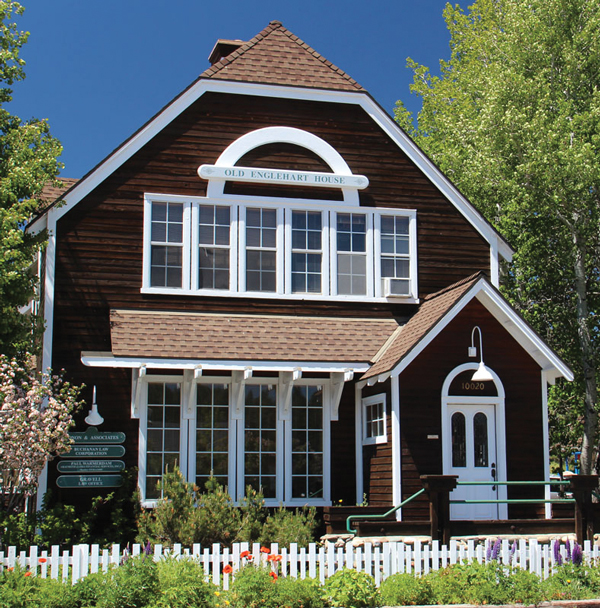
Englehart home
According to Truckee Donner Historical Society, William Englehart was born in Butte, Mont., in 1885 and arrived in Truckee with his parents in 1892. As a young man he entered the grocery trade and later Englehart operated a theater in Truckee for many years before becoming the owner-operator of the Truckee Soda Works.
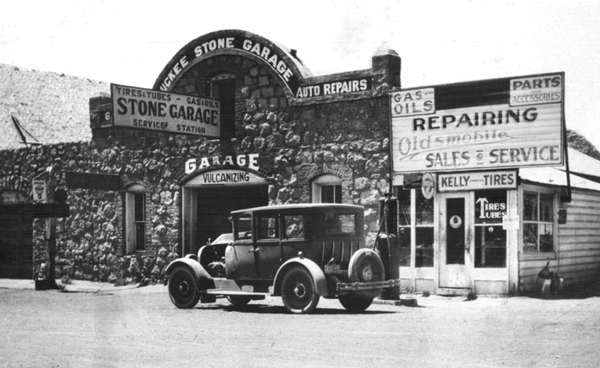
Old Stone Garage
The original location of Gray’s toll house is around the corner at 10060 Bridge St. now home to Totally Board snow and skate shop. This retail business is housed in a formidable rock building known as the Old Stone Garage built in 1909 by European-trained stone masons for use as a livery and auto garage. The owner D. J. Smith invested in granite construction as insurance against loss in the fire-prone town.
In 1865, anticipating the construction of the nation’s first transcontinental railroad over Donner Pass and east into Nevada, a blacksmith from Dutch Flat named S.S. Coburn set up a stage station with restaurant and saloon just west of Gray’s business. Coburn’s Station was soon crowded with men assigned to work at the advance camp for Central Pacific Railroad. Due to all the lucrative timber and railroad activity, the small hamlet along the Truckee River known as Coburn’s Station grew rapidly. In April 1868, newspapers reported that the residents of Coburn’s Station had changed the name of their town to Truckee. Two months later, when much of it burned down, including Coburn’s structures, the name Truckee achieved permanent status.
Former Washoe village
Gray’s family was certainly not the first to live in the area. For thousands of years, nomadic Indians relied on the life-sustaining Truckee River as a vital resource for their survival. During the warmer months they hunted game, fished and foraged for berries and medicinal plants along its banks. Washoe and Northern Paiute tribes routinely caught large cutthroat trout that abounded in the clear, cold mountain water. It was an important addition to their limited diet of pine nuts, grass seeds and small game. The Washoe called the Truckee River a’wakhu wa’t’a, and local archeologist Susan Lindstrom has reported that before downtown Truckee was built, the site was a Washoe village named K’ubuna detde’yi.
Origins of Truckee’s name
There are variations on the origination of the word Truckee. One account claims a Canadian trapper named Baptiste Truckee discovered the river while searching for water with an exploration party led by Joseph R. Walker in 1833. Another is that a friendly Paiute Indian chief known as Tru-ki-zo frequently said “tro-kay” during encounters with early pioneers. When Chief Tru-ki-zo met early settlers heading west, he would volunteer to lead them to safety. As they scouted the forbidding terrain, the chief repeatedly spoke words that sounded like tro-kay or something phonetically similar. His frequently spoken phrase became Truckee and eventually the chief adopted it as his common name.
Truckee’s granddaughter Sarah Winnemucca, the first female Native American to write a book in English, said that the Paiute word “Truckee” means “all right” or “very well.” It makes sense that the friendly chief would reassure wary emigrants with words that essentially meant, “Everything’s going to be ok.” After Chief Truckee helped guide the 1844 Stephens-Murphy-Townsend wagon train up the Truckee River Canyon and into California, the grateful emigrants named the river after him. | truckee.com


