


By WILL RICHARDSON
In the 1800s, wealthy Americans engaged in a Christmas tradition known as a side hunt, where teams would go afield with their guns and whoever brought in the biggest pile of birds won. The American conservation movement was in its early stages in that era and ornithologist Frank Chapman proposed an alternative holiday tradition: a Christmas bird census that would count birds during the holidays rather than shoot them. Thus, on Christmas Day 1900, birders held 25 Christmas Bird Counts ranging from Toronto, Ontario, to Pacific Grove.
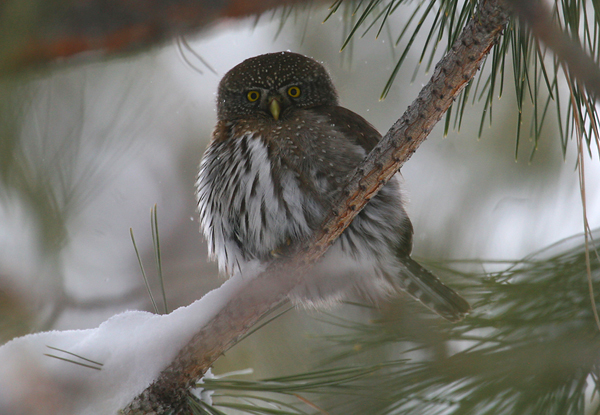
Each year, from Dec. 14 through Jan. 5, tens of thousands of volunteers head out into the winter landscape to count birds for a day.
Fast forward 120 years and the tradition has not only taken hold, it has exploded in popularity, making the Christmas Bird Count the largest and oldest citizen-science project in the world. Each year, from Dec. 14 through Jan. 5, tens of thousands of volunteers head out into the winter landscape to count birds for a day. The 2019 count had a remarkable total of 2,646 counts, spanning locations all over the world and involving 81,601 observers. In those years since Chapman’s first count, a priceless database of bird populations has been developed.
Birders at Lake Tahoe established a count in 1975 when there was an Audubon Society chapter based out of South Lake Tahoe for a brief period. Tahoe Institute for Natural Science (TINS) became involved with the South Lake Tahoe count in the late 1990s and has coordinated the count since 2004.
The annual event provides critical data about bird population trends and helps inform conservation efforts; every count makes a contribution toward that larger dataset. Indeed, this is the primary goal from the perspective of the Audubon Society, which compiles the data from the thousands of counts across the globe. Some counts also become fiercely competitive, with a primary objective of tallying more species than their rival counts.
A few Texas and California counts regularly pass 200 species for their day, while counts in far northern Canada might be lucky to manage two species. At Tahoe, we usually see more than 60, but early-season storms, count-day weather and ice conditions make all the difference. Last year, TINS broke its own record with 87 species, a fairly remarkable achievement for a count in the mountains.
TINS’ goals for the count extend beyond mere data collection because the event is a great opportunity to bring the birding community together in the winter at a time when many birders have hung up their binoculars for the season. In recent years, the count started out with most participants meeting at a local coffee shop and then birding as a group for several hours. At the end of day counters would reconvene to share their sightings, enjoy pizza and compile an overall tally. Unfortunately, COVID has pressed pause on those traditions for now, but TINS intends to reboot the end-of-day tally this year via videoconferencing.
The 2021 South Lake Tahoe Christmas Bird Count will be on Dec. 15. All birders are welcome to participate either by joining a small team of counters in the field or by tallying birds in their own backyard — feeder watchers contribute a lot of data.
TINS also needs volunteers for the mid-winter Bald Eagle Count on Jan. 14, 2022. | tinsweb.org
Will Richardson is the co-founder and executive director of TINS.
Christmas Bird Count
Dec. 15 | South Lake Tahoe
Tahoe Big Year Celebration
Jan. 5 | Virtual
Bald Eagle Count
Jan. 14 | Area venues


