


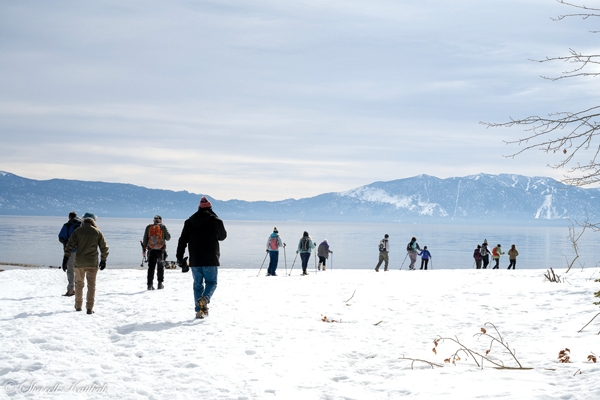
It’s a sunny, crisp, cold winter morning when Tahoe Weekly Publisher Katherine Hill and I set out to learn more about lake hydrology and human’s impacts on it. The snowshoe outing is a joint partnership Tahoe Institute of Natural Science (TINS) and Tahoe Rim Trail Association (TRTA). The trek led by Jennifer Coons, a TRTA guide, and Sarah Hockensmith, TINS naturalist, began at Sugar Pine Point State Park.
Lake Tahoe is a magnificent body of water and the region’s heartbeat. There is no doubt that there is always more to learn about it. Outdoor education and sustainable recreation are ways people can learn about the region and become stewards of Tahoe’s pristine environment. Hockensmith and Coons are wells of information, pointing out key facts about Lake Tahoe and its surrounding environment. TRTA guides Jim Mrazek and Sharell Katiban assisted in the trek. The snowshoe event drew people from Carson Valley, Nev, and Roseville and included Karin Regnstrom, a semi-retired molecular biologist who volunteers at Tahoe Environmental Research Center. Regnstrom was a delightful addition to the group and I enjoyed chatting with her about her work and the need for better messaging regarding Tahoe’s trash problem.
Sustainable recreation is a beautiful way to learn about Tahoe and immerse in nature.
We walked by the magnificent Hellman-Ehrman Mansion built in 1902 and General Phipps’ cabin, the first permanent settler of record on Lake Tahoe’s West Shore. Coons offered the group a little Tahoe history. We snowshoed down to the beach where snow levels had melted. I found myself snowshoeing in the sand. It’s not an easy feat.
First some basic facts about Lake Tahoe: it has 72 miles of shoreline, 191 square miles of surface and more than 312 square miles of watershed. The average temperature is 41.9 degrees in the winter and the deepest part is in Crystal Bay. It is as deep as the Empire State Building is tall. The group gazed out to the clear crystal waters taking in the information. We trudged on through the sand until we arrive at a snow-covered meadow. Hockensmith took time to explain the importance of meadows.
“The meadows around the lake consist of a lot of different grasses and plants. As water filters down from a mountain and pushes through a meadow, basically, those plants, soil and grasses take all those different sediments, filter out the different particulates and then push out fresh water. That’s another one of the main reasons why meadows help clear waterways. We have 63 streams that do flow into Lake Tahoe,” she said, adding that there are more than 1,000 different types of species of plants in the Tahoe region, including one of the rarest plants in Tahoe, the Tahoe yellow cress.
“This plant doesn’t grow anywhere else in the world. The Tahoe yellow cress is a mustard plant. It’s not the most beautiful looking flower. It’s a tiny yellow flower that grows on our beaches, but it only grows here,” said Hockensmith.
GUIDED SNOWSHOE TREKS
March 27 | Winter Wildlife Snowshoe with TINS | Diamond Peak
March 28 | Sunset Snowshoe Tours | Resort at Squaw Creek
March 29 | 55+ Snowshoe Hike | Area venues
April 15 & 16 | Full Pink Moon Tours | Tahoe Adventure Company
April 16 | Moonlight Snowshoe Tour | Wylder Hope Valley
Coons pointed out the majestic sugar pines that grow on the edge of the forest. Their enormous cones dangle from the branches. They are a rare species of pine tree. When the cones fall on the ground, it is essential to leave them to seed and grow more trees.
We continued along the beach. Coons mentioned the importance of wetlands and marshes in helping slow down and prevent the spread of wildfires. We looped the shore and went through the park to our car.
Throughout the walk, Coons talked about importance of being good stewards of the environment. Sustainable recreation is a beautiful way to learn about Tahoe and immerse in nature.
Many educational guided tours are offered throughout the year and are listed in Tahoe Weekly’s event calendar in each print edition and at TheTahoeWeekly.com.
Self-guided tours
Self-guided snowshoe outings are another way to explore Tahoe. The state parks and national forests in the area have many places in which to snowshoe or hike on your own year-round. Here’s a few to explore:
East Shore | Sand Harbor and Spooner Lake state parks.
North Shore | North Tahoe Regional Park and Page Meadows.
South Shore | Camp Richardson, Taylor Creek and Pope, Kiva and Baldwin beaches.
Truckee | Donner Memorial State Park, Castle Peak and Summit Canyon off of Old Hwy 40.
West Shore | Blackwood Canyon (Sno-Park permit required) and Ward Creek State Park.


