


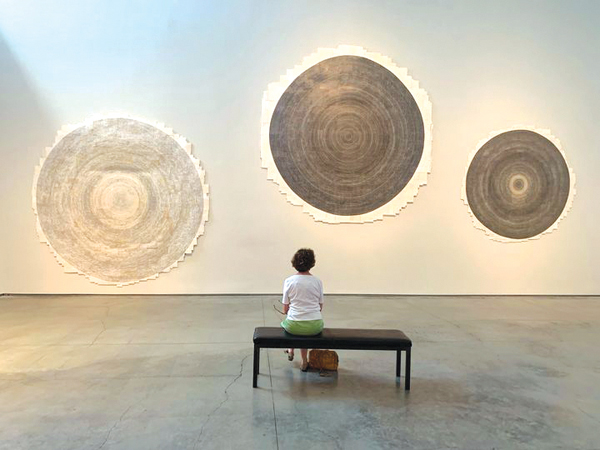
Galen Brown’s art has been described as meditative, mesmerizing and hypnotic and at first glance it’s easy to see why. His style of art takes years to make and if you look closely at any of his projects, you’ll notice the painstaking detail and commitment he’s put into every part of his creations.
Brown is an eclectic, interesting man and his current studio space in Carson City, Nev., is an artist’s playground filled with interesting materials, past art installations and his current work. I met him there with Frances Melhop, owner of the Melhop Gallery 7077 in Zephyr Cove, Nev.
I first noticed Brown’s art in the restaurant foyer at Clear Creek Tahoe in 2021: a gigantic floor-to-ceiling serial linework. A few months later, I noticed a much smaller piece in that same style in Melhop’s office at her gallery. She told me it was one of Brown’s and reaffirmed that the one in Clear Creek Tahoe was his, as well.
“The [used Christmas trees piled on the curb] bothered him, so he started collecting the discarded trees and storing them in his studio. He then spent the following decades repurposing them into art.”
Brown was born in 1959 in Reno, Nev. Brown’s parents had a home in Kings Beach, as well, where he spent most of his childhood. He started racing on the Mt. Rose Falcons ski team when he was age 6 with Olympian Tamara McKinney who joined the team when she was 4. His father worked for what is now Palisades Tahoe and also owned a boat rental/seaplane business; in the summer Brown cleaned boats with his sister in Homewood.
Brown didn’t have a lot of exposure to art when he was younger; the closest he came was when he took a drafting class in the eighth grade. There was a small creek next to his house that ran from the mountaintops into the lake and during a drought period in the 1970s, trout would get stuck enroute to the lake. Brown’s Labrador retriever alerted him to the struggling fish and he helped them out by building rock walls to help reinforce the waterways.
Later, a well-known sculpturer did something like that to bring to light the plight of the aquatic vertebrates, long after Brown did.
“I was building those channels 20 years before it became art,” he said.
“I think that creek was a turning point for your art,” Melhop added.
After taking that drafting class in junior high, Brown thought that would be the path he would take and he studied engineering, architecture and design at the (now closed) Phoenix Institute of Technology in the late 1970s. From there he ended up in graduate school at San Francisco Art Institute. He began honing his craft toward fine art during this time. His work was included in group shows from the Bay Area to Japan.
Many of his projects take years to complete and are perhaps never quite done. For instance, as we walked through Brown’s workspaces, I noticed skinned, painted and altered rings around tree trunks as thin as singular branches, hanging from the ceilings or leaning against the walls. This was part of an art installation displayed at the Nevada Museum of Art. He etched the intricate lines around the pared-down base of one with a burning tool that reminded me of a car’s mini jumpstart pack. Another tree base was wrapped in gold leaf, another in worn shoes. I spotted white painted bases, teal painted bases and several more with hundreds of engraved rings in them.
“It took a couple of months to burn the lines, a couple of months to skin the tree; you have to wait until it’s dry,” Brown said.
He explained that he got the idea for this series from visiting a former girlfriend in San Francisco after Christmas and saw dead trees piled up on the street corners. The waste bothered him, so he started collecting the discarded trees and storing them in his studio. He then spent the following decades repurposing them into art.
He mostly uses materials that are humble, found or leftover from other projects. He only buys ink pens, pencils and/or other necessary tools. He has played with other mediums, as well, using mezzotints and beeswax on museum board.
Brown pulled an abstract work out of a drawer that he created as a graduate school project: a work of encaustic bronze, brass, dust and rust he obtained from the Golden Gate Bridge, then hammered into the paper.
No matter what kind of medium Brown uses each of his pieces brings a certain kind of magnetic energy. His level of detail and diligence is unmatched compared to anything I’ve ever seen before.
View his work on the Melhop Gallery 7077 website. | melhopgallery.com


