


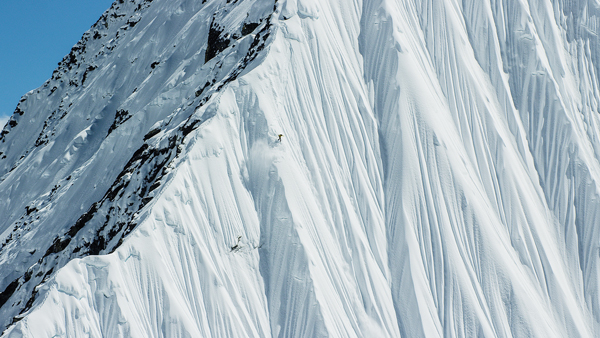
Magic hour is that time just after sunrise or right before sunset when everything seems somehow perfect. Capturing this special moment was the mission of Steve and Todd Jones of Teton Gravity Research in their newest film, “Magic Hour.” Of course, they had a little help from their little brother, Jeremy.
Children of the ’70s, the Joneses grew up on Cape Cod in the village of Centerville, Mass. Steve is the oldest followed by Todd who is three years younger and Jeremy who is six years younger. They were part of the first generation of their small town to surf the notoriously unruly waves of the Codfish Coast.
“We taught ourselves how to surf making every mistake you can make and freezing our asses off,” says Jeremy Jones, who now lives in Truckee.
“There are no drones or helicopters allowed in national parks and wilderness, so they are hiking 5,000 feet to an opposing peak to film these lines. …The amount of energy and knowledge to get these shots is really out of this world. It’s totally next-level, foot-powered documentation.” –Jeremy Jones
In the winter they traveled to Stowe, Vt. where their grandfather had a cabin. Back then, snowboarding wasn’t allowed at the resort, so the Joneses skied and sometimes hiked their snowboards into the enchanting Green Mountain backcountry to ride hidden glade corridors cut by locals.
“This was the Burton Backhill era,” says Jones, referencing the original snowboard prototypes introduced by Jake Burton in 1979. “You had to hike to get vertical.”
When Stowe finally allowed snowboarding in 1987, 12-year-old Jeremy was first in line to get certified.
“It was clear at a young age, we’re moving to the mountains as soon as we can,” he says. “We just loved everything about it. The more adventure, the more fired up we were.”
Jeremy began professionally snowboarding at age 16 and found himself renting a closet in Tahoe soon thereafter. Meanwhile, Steve and Todd had moved to Alaska where they worked as fishermen and heli ski guides. Eventually, they decided to invest their savings in camera equipment. They moved to Jackson Hole, Wyo., and started Teton Gravity Research in 1996.
Watch the trailer for “Magic Hour”
They’ve since made more than 50 independent snow sports films including classics such as “The Continuum” (1996), “Uprising” (1998) and “High Life” (2003). They’ve filmed commercials for Apple, Nissan, Jeep, Energizer and The North Face and made television for NBC, Outside and Showtime. They also produced Jeremy’s groundbreaking trilogy of “Deeper” (2010), “Further” (2012) and “Higher” (2014) in which he pushed the limits of snowboarding to some of the most remote and extreme locations on the planet. In “Magic Hour,” Jeremy makes a cameo camping and splitboarding the backcountry north of Teton National Park.
“There’s some groundbreaking ‘schralpinism’ here,” says Jones. “That’s a mix of alpinism and shredding. There are no drones or helicopters allowed in national parks and wilderness, so they are hiking 5,000 feet to an opposing peak to film these lines. It’s multiple people to get a camera in one spot. The amount of energy and knowledge to get these shots is really out of this world. It’s totally next-level, foot-powered documentation.”
Around 15 years ago, Jones discovered splitboarding, which allows a snowboard to split apart into two skis. With this simple technology, he was able to ski into previously unreachable places deep in the wilderness.
“So much of my focus has been on finding the best lines and riding them in optimal conditions,” he says. “A machine is actually limiting in this case. There are some places where you can’t take a chairlift or helicopter. If you get dialed in on walking for days and winter camping, you can have your own universe without anyone around.”
Jones founded Jones Snowboards in 2008 to manufacture his own designs. More recently, he’s been experimenting with binding-less snow surfboards and a new line of outerwear. He is also the founder of Protect Our Winters (POW), a nonprofit dedicated to helping the snow sports industry combat climate change. Jones points to the recent passage of the Inflation Reduction Act as victory for the movement and he believes lobbying from ski resorts in states such as West Virginia made a difference securing the clean energy aspects of the bill.
As far as working with his brothers, there’s nothing better.
“It’s very natural,” he says. “We’ve been doing it forever. It’s been amazing to do all these cool projects and have my brothers right next to me. They’re dreamers, but not afraid to grind it out to make things happen. They love turning up the volume to 11 in all aspects of life, just going for it and giving it everything they have. We live and breathe this stuff. It’s in our soul.” | jonessnowboards.com, protectourwinters.org


