


Duane Leroy Bliss made a fortune as a timber baron, whose industry destroyed much of Lake Tahoe’s old growth forest in the 19th century. But, Bliss also understood that once the trees grew back that the region could become a popular tourist destination.
To accelerate future re-growth, Bliss ordered loggers to leave intact trees less than 15 inches in diameter at the base; some particularly scenic locations were spared the ax completely. Spectacular D.L. Bliss State Park, which consists of 957 acres with nearly 15,000 feet of shoreline, exists because of Duane Bliss’ vision and philanthropy.
After a series of California gold rush adventures, 27-year-old Duane Bliss crossed the Sierra and settled in Gold Hill near Virginia City, Nevada Territory. He managed the Comstock’s first quartz mill and then used his savings to become a partner in a small local banking firm. In 1863, he married Elizabeth Tobey from Massachusetts, a strong relationship that would last until Duane’s death in 1907. The couple had five children born in Nevada: William Seth, Charles Toby, Hope Danforth, Walter Danforth and Duane Leroy Jr. All four sons would contribute professional energy and talent to the Bliss family legacy known as the Lake Tahoe Railway and Transportation Company, a business that changed Tahoe forever.
Bliss’ early Gold Hill Bank venture was short-lived, however, as the San Francisco-based Bank of California purchased the firm in 1865 and converted it into a branch of their own. But, due to Bliss’ reputation for integrity, Bank of California management kept him on as their point man on the Comstock and in charge of acquiring right-of-way lands for the construction of the bank’s Virginia & Truckee Railroad project.
But, Bliss wasn’t planning on a career with the Bank of California. In 1873, he became president and general manager of the Carson and Tahoe Lumber and Fluming Company with plans to harvest the trees in the Tahoe Basin to supply timber and fuel wood for Comstock mining operations. The company had three divisions – logging, milling and transportation – with its center of operations at Glenbrook, Nev., on Tahoe’s East Shore. Bliss had built a nice summer home in Glenbrook the year before.
The demand for wood products in Nevada’s mining industry seemed insatiable, but Bliss and his partners in the Carson Tahoe Lumber Co. were intent on fulfilling it. The company built sawmills at Glenbrook and deployed hundreds of experienced loggers from Canada into the Tahoe forest to extract fir, pine and cedar. Armed with two-man, cross-cut wood saws, the Canadian lumberjacks whip-sawed their way through the vast stands of conifers. Chinese wood choppers were employed to de-limb fallen trees and to cut the abundant white fir into cordwood for the furnaces and boilers on the Comstock. Trimmed, raw logs were either dragged or flumed to the lake where steam-powered tugs towed the rafts of boomed timber to Glenbrook for processing into cut boards of lumber.
One of these tug boats was the iron-hulled steamer “Meteor,” shipped in from Delaware in pieces by rail, hauled over the mountains in wagons by draft animals, and then reassembled at Glenbrook. Launched in 1876, “Meteor” was capable of 23 mph and was considered to be the fastest inland steamer in the world at that time, as well as the speediest boat on the Pacific Coast.
After milling at Glenbrook, finished wood products were hauled up the steep slope above the lake by an innovative 9-mile-long narrow gauge track – the Lake Tahoe Railroad. Bliss engineers constructed a trestle switchback for locomotives to climb 900 feet up a mountain face from the Glenbrook lumber mills to the headwaters of Clear Creek near Spooner Summit. There, the sawed lumber and cordwood were tossed into a water flume for transport down the east face of the Carson Range, where it would be transported to the Comstock mines via the Virginia & Truckee Railroad. Over the span of 23 years, the company cut about three-quarters of a billion feet of old growth timber from the Tahoe Basin, plus half a million cords of fuel wood. It was 19th century industry on a grand scale, and Tahoe would never be the same.
For two decades, Duane Bliss had been well aware that the timber operations would end someday, and by 1893 that day had come. Even though he was 60-years-old and wealthy enough to retire in luxury, Bliss decided to leap into a new business; Tahoe tourism.
The Lake Tahoe Transportation Company would be a family run enterprise designed to modernize and up-grade the Lake Tahoe experience for guests visiting from around the world. That vision would require three interrelated projects including a luxurious passenger ship, a railroad to connect Tahoe City with the Southern Pacific line in Truckee, and a world-class destination hotel.
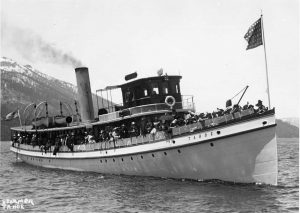
Bliss inaugurated his three-pronged business model with a boat. The steel-hulled steamer “Tahoe” was launched at Glenbook in June 1896. Nearly 170 feet long, with two powerful engines, she could transport 200 passengers at 25 mph. Built in San Francisco, the ship was decked out with a nicely appointed dining room and saloon, along with space for freight and mail operations. Christened “Tahoe,” this sleek vessel with clean lines was fondly known as “Queen of the Lake,” a role she performed faithfully for nearly 45 years.
The next phase of the plan was a railroad to connect Lake Tahoe to Southern Pacific lines at Truckee. Bliss purchased all of the rolling stock and infrastructure at Glenbrook, and then bought more secondhand motive power and logging cars from another defunct Tahoe logging operation – the Lake Valley Railroad, a shortline near Bijou. Three locomotives and about 60 or 70 logging flatcars, plus nearly 600 tons of used narrow gauge track, were barged to Tahoe City. Many of the buildings at Glenbrook and Bijou, including machine shops, employee housing and even one of the large sawmills, also were floated across the lake. The barges were pulled by the “Meteor” and another steamer, called “Emerald Number Two,” part of the three-steamer fleet now owned by Bliss’ new company. Tahoe City became the epicenter for the operation, with well-equipped maintenance and repair shops constructed for both railroad cars and maritime vessels. In 1898, Bliss started a new corporation, the Lake Tahoe Railway and Transportation Company, to build his railroad. The move rolled all of Bliss’ commercial property into one private entity, with all stock owned by Bliss family members. Stay tuned for part three in the next issue.
By Mark McLaughlin
Historian Mark McLaughlin is a nationally published author and professional speaker. Find Mark’s books at stores or thestormking.com. You may reach him at mark@thestormking.com. Follow Mark’s blog at tahoenuggets.com.
READ MORE


