


This weekend, Sierra Boat Company in Carnelian Bay is hosting the Concours d’Elegance wooden boat show, a gathering of some of the world’s most beautiful watercraft. The 2013 event is showcasing the collection of Alan Furth, and features the most “eccentric, elegant, and rarest wooden boats ever built.” This annual summertime celebration of Tahoe’s boat history reminds us of how maritime vessels shaped the region’s earliest days.
There were many notable boats that plied the waters of Lake Tahoe during the 19th century, but it appears that the first vessel to work commercially on Big Blue was the “Iron Duke,” a sailboat captained by Thomas Jackson. From 1860 to 1870, Jackson delivered mail around the lake. He sailed from settlement to settlement, which took him about a week.
The first steam-powered watercraft to operate on Lake Tahoe was the “Governor Blasdel,” named after H.G. Blasdel, Nevada’s first head of state. The boat was hand-built by Cpt. Augustus Pray, one of the first settlers in the Basin, who owned a saw mill on the south side of Glenbrook Bay on Tahoe’s East Shore. Capt. Pray, an experienced seaman who had sailed both the Atlantic and Pacific coasts, constructed the boat from scratch. He laid out the keel, steam-bent the wooden ribs and milled side boards for the hull. The boiler hardware and steam engine were acquired in San Francisco and the parts shipped to Glenbrook via freight wagons. Capt. Pray built the” Governor Blasdel” as a tug boat to tow large rafts of cut timber across the lake to his East Shore mills. Launched in June 1864, the 42-foot-long, side-wheeler operated reliably for more than 12 years, not only hauling timber and freight, but also ferrying thousands of happy tourists around Lake Tahoe. In 1877, the hard-working little steamer broke up in a storm and its debris washed up onto the Glenbrook beach.
The extraordinary demand for lumber and cordwood for Nevada mines inspired other entrepreneurs to introduce their own steam powered tug boats. In 1870, Cpt. Howland and B.F. McCoy launched the “Truckee,” a 40-foot-long, wood burner capable of about 9 mph. For its first year, it was used exclusively to haul log booms across the lake, but in 1871 it was purchased by William Campbell, a Truckee businessman and owner of the new Hot Springs Resort near the North Shore state line. Campbell invested in major capital improvements for the watercraft, including a new boiler. He then began promoting it as the best passenger boat cruising Lake Tahoe. But, tourism was still in its infancy in the region and Campbell continued to use the boat primarily for hauling freight or towing logs to Glenbrook until 1881 when it was destroyed for scrap.
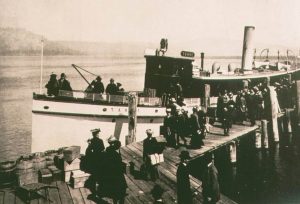
In 1872, the “Governor Stanford” started operating on the lake, the first Tahoe steamship built exclusively for tourist transportation. Based in Tahoe City and skippered by Cpt. Todman of Carson City, the “Governor Stanford” was a side-wheeler like the “Blasdel,” but it had an expansive upper deck for sightseeing. Nearly 100 feet long and 15 feet wide, this large steamboat was criticized for being slow, but it could ferry up to 125 passengers around the lake in just eight hours. Owned and captained by W.H. Lapham of South Tahoe, the steamer cost $15,000 and required a crew of eight men to operate. It may have been the first large-scale passenger ship on Lake Tahoe, but guests complained of no tables for dining (they had to stand at the bar in the saloon to eat) and cheaply made alcohol. The lack of an awning to protect passengers from the high altitude sun was a disappointment for some, but the short smokestack that spewed cinders and ash on them generated the most complaints.
These new passenger steamships with their regular schedules attracted more and more visitors to Lake Tahoe, but especially for Tahoe City, a vital transit point for stagecoaches coming from the railroad at Truckee. Confidence in a future economy based on tourism increased property values for retail businesses and the hospitality industry. In December 1872, William Pomin, owner of the Tahoe Restaurant in Tahoe City, sold his property for $3,000, which was more than double its estimated value just a few months previously.
In June 1896, the steel-hulled steamer “Tahoe” was launched at Glenbrook. At nearly 170 feet long, the “Tahoe” was the largest and most elegant steamer to sail Big Blue. Powered by twin engines with a combined 1,200 horsepower, she could transport 200 passengers at 25 mph. Timber baron Duane L. Bliss had the ship built in San Francisco and then railroaded to Carson City before oxen-drawn wagons hauled it in sections over the mountains to Glenbrook. The ship was decked out with a nicely appointed dining room and saloon, along with space for freight and mail operations. Initially powered by wood, Bliss converted it into an oil burner, which condensed the exhaust and made it much quieter than all the other steamers on the lake. This sleek vessel with clean lines was fondly known as the “Queen of the Lake,” a role she performed faithfully for nearly 45 years.
Historian Mark McLaughlin is a nationally published author and professional speaker. Find Mark’s books at stores or thestormking.com. You may reach him at mark@thestormking.com. Follow Mark’s blog at tahoenuggets.com.


