Was I nervous? You bet. In the end of 1949, 3 feet of powder snow had fallen overnight at a new ski resort called Squaw Valley.
Donner Summit was closed so there were no customers and for the first time in my life I was pointing my brand new 16MM Bell and Howell camera at the ski school director, Emile Allais. Emile was twice world champion before World War II and was skiing with his own, unique ski technique. I had learned about the French technique during the previous winter when he was teaching the Arlberg technique for Otto Lang in Sun Valley and thought it made so much more sense and brought a beginner along much more quickly.
I had only taken 12 rolls of film with my new camera and they were either from the beach of surfers or from riding on my surfboard with my camera in a waterproof box that I had built the summer before.
For my first attempt at ski photography, I had naively left my camera in the brown leather case with red velvet lining that it had arrived in on my doorstep in Sun Valley six months earlier.
I had been hired by airmail as a ski instructor for this new resort with the first double chairlift west of Colorado. The ski patrolmen who were skiing with Emile and another instructor, Stan Tomlinson, handled the powder effortlessly and I used what experience I had shooting 8MM footage for the previous three winters of Ward Baker and other people and interesting things at Sun Valley.
My camera was loaned to me by Chuck Percy, who was then the president of Bell and Howell, to help me get started in my film career of travel films … a loan that I paid off in a little less than three years hence.
With my limited knowledge of camera angles, shadows and backlighting, the only difference was that the images were going on to 16MM film stock instead of 8MM.
My rucksack was a $6 Army surplus canvas bag on a metal frame with canvas straps. The first time I took the camera out of the rucksack and the leather carrying case, I realized that I had made a major mistake in not having it ready to come out at a moment’s notice. I realized this trying to get ready to photograph the right backlit, untracked powder snow. It took too much time to open the rucksack out the leather suitcase, check the F-stop and start filming.
With film costing $11 a roll including processing, I had only saved up enough money to buy five rolls of film. Those five rolls of film was only the equivalent of 12½ minutes of ski time. By the time the sun had disappeared behind the ridge, my hands were frozen and I was nervous the next five or six days until the footage arrived back and I could look at it. I was surprised to discover that most of those first five rolls of film were good enough to include them in my first feature-length ski film, “Deep and Light.”
Over the course of the winter, on my $31.25 a week payroll, I managed to somehow ferret away enough money to buy 37 more rolls of film and from that I created that first film that I showed in the fall of 1950.
Relying on the experience of my 8MM photography days with Ward Baker when were living in the teardrop trailer for two winter seasons, I was able to shoot some footage of people trying to get up the rope tows, as well as, a young girl skiing with soft galoshes that rotated her feet at least 90 degrees without ever turning her skis.
In the late spring of 1950, the editor and publisher of Western Skiing, Lester Jay, was at Squaw Valley. I rented a 16MM projector and showed him my footage. Jay liked what he saw and offered to help me get started in the feature film business.
That first camera was like a magic carpet for me to visit almost every ski resort with a chairlift or better in the world, from Zermatt to New Zealand and everything in between.
For the first 14 years that I made the films, I did everything connected with the productions. I selected where I would go, handled the travel complexities, managed to get the best footage I could and then back to the office in the spring and summer to edit, choose the music (from the public domain as I couldn’t afford to pay for music), book the venues and then start the travel all over again to the roughly 110 cities each year that wanted to see the film.
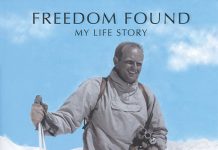
As the years roll by, I have all those memories of experiences filming, traveling and meeting exciting people all over the world. It’s time to finish up my autobiography and weed through thousands of photographs of those memories. My autobiography might just be one man’s historical chronicle of the growth of winter snow sports from a total of 13 chairlifts in North America to what it is today – sometimes as many as 25,000 skiers on a single day at Mammoth and Vail.
It’s been a fun journey of millions of miles from those first rolls of film taken at Squaw Valley to be chosen to be the Honorary Director of Skiing for the Yellowstone Club, the only private ski/golf resort in the world.
Warren Miller is history’s most prolific and enduring ski filmmaker. Visit warrenmiller.net or visit his Facebook page at facebook.com/warrenmiller.