


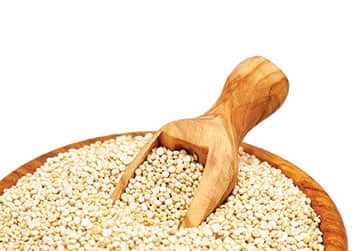
 Wow, I didn’t realize just how wide I could open Pandora’s Box with the kale breakfast smoothie and the mention of super foods. Hopefully, the article that comes out this coming week will help answer a lot of the questions I’ve been getting wherever I go, but since I have had a few inquiries about quinoa, I thought I would do a little more research on the grain.
Since, I have to admit, I have never had quinoa before, the first thing I did was picked up a box. According to the directions, all you do is cook it like you would cook rice. That is, bring 2 cups water and 1 cup of quinoa to a boil, turn down to a simmer and cook covered for about 20 minutes. Turn off the heat and let sit 5 minutes before removing the top and fluffing with a fork. Because we are at elevation and things don’t take the same amount of time to cook, it did take closer to half an hour, but no big deal.
Basically, you are looking for all the water to be absorbed and the quinoa should be tender with still that slightest crunch like al dente rice. It does have a nice, somewhat nutty, flavor, but the second batch I cooked like I would rice with five more additives and I thought it came out with much better flavor.
First, I sautéed some onions in butter, you can use olive oil if you prefer, and then added one carrot cut in half lengthwise and then in half, and two sticks of celery cut into four pieces each. The carrot and celery I don’t normally add for rice, but I just had a feeling I would like this. Then, I also substituted chicken broth for water, which you could also use vegetable broth instead. Once cooked, I easily removed the carrots and celery and used them later. The results were a much more flavorful quinoa, which I had with a stir fry, but I could also see it being really good for salads, side dishes and all kinds of things. One thing is that the box said it had been pre-washed and I thought it was fine, but almost everywhere I looked it said to be sure to rinse thoroughly for 2 minutes, even the already washed quinoa, to remove the outer coating, which can be bitter.
Now that I’ve cooked a few batches, I had to compare it with other grains and see what makes it a super food. I went to the cupboard and pulled out my stock of grains to check the nutrition labels on them to compare. What did I compare it to? I had regular Uncle Ben’s long grain rice, Arborio rice for risotto, couscous, Tabbouleh, and a long grain and wild rice blend, I was out of my usual brown rice so I looked that up. I have to admit, looking at the nutritional labels of all of the various grains still left me wondering why quinoa is so super.
As a matter of fact, if you didn’t read the history of quinoa on the box, which tells you it is a super food due to the fact it has all nine essential amino acids in it, and just looked at the nutritional value, there is little difference and, in some cases, there are more of the daily recommended essentials included in some of the other products. What’s the conclusion? Well, it means back to the computer to do more research.
The first thing I did was to eliminate white rice from the mix. Why, because white rice is not really a whole food. It starts out just like brown rice, but during the refinement process it loses most of its nutritional value. All the nutrients you see on the box are added back in which is why it says enriched on the box. Couscous is limited in its nutritional value when compared with quinoa and is, in fact, lower down the list than wild rice in total nutritional value. Wild rice and brown rice were on par with quinoa in a few categories like calories, which it was slightly better, but again, everywhere I looked, the box label doesn’t do the quinoa justice and it handily beats out any of the rice. The closest competitor that I had in my cupboard was, surprisingly, the Tabbouleh. Going by just the box, it would really appear that the Tabbouleh was a clear winner with it showing far less calories than the quinoa, but once I researched more, it just kept falling a little shorter in almost all other categories leaving quinoa as the clear winner in the total nutritional value of the grains. By the way, quinoa is not really a grain but rather a seed, but because of all its properties and the way it is prepared, it is considered a grain. Not only considered a grain but it is considered to be a super food. Enjoy.


