


When the bombs dropped on Pearl Harbor on Dec. 7, 1941, 15-year-old Bill Briner was skiing in the sand dunes off the Mount Rose Highway. He knew the bombing would mean he would eventually go off to war, but he told himself he would “go back up there after the war, to ski again.”
Now at 90 years old, Briner is still skiing. While skiing is in his blood, it has been his hard work over many decades for a number of public agencies and private businesses that has made a profound impact on the Tahoe community and the State of California.
“A man of many talents: Accomplished photographer, sailor, business operator and public official who always thought less about himself
and more about the public good.”
– David Antonucci
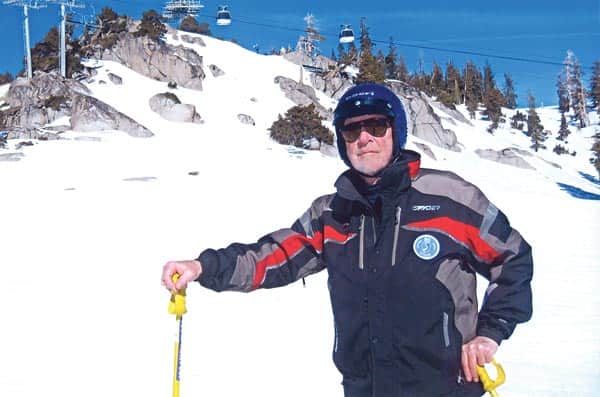
Briner lied about his age to join the Navy at 17 and fought in World War II in the Navy Submarine service between 1944 and 1946. After the war, he moved to Tahoe in 1946 with his mother Dr. Monica Briner, stepfather Ralph Seers, and brother Conrad Briner to turn an old Tahoe home into a West Shore lodge, restaurant and marina that they called Sunnyside Lodge.
At 21 years of age, Briner’s responsibilities at Sunnyside included taking care of boats in the marina, working the bar and cooking in the kitchen. Later, his wife of more than 60 years, Fritzi Briner, would often make beds and clean rooms. (They have two sons, Mark and Drew). They helped run Sunnyside until it was sold in 1972.
Sunnyside back then was only open in the summer, which gave Briner the opportunity to teach skiing at Squaw Valley beginning with its opening in 1949. After just a year, his teaching was temporarily interrupted by the Korean War, when he was drafted for his second war and two more years of military service.
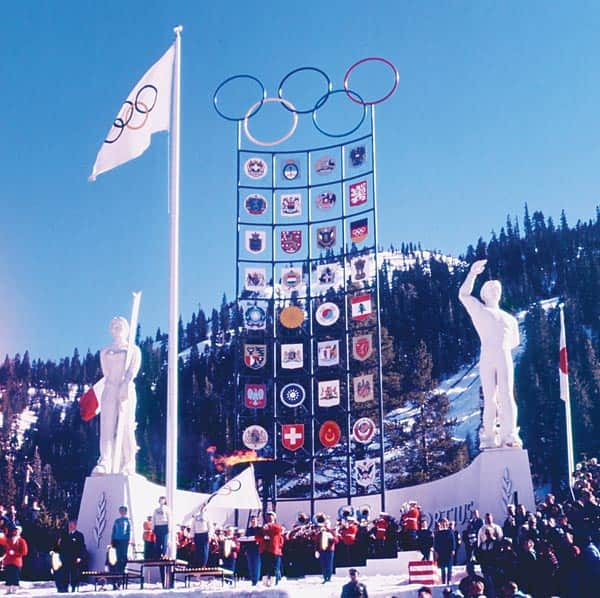
The Tower of Nations during the 1960 Winter Olympics
After the Korean War, Briner returned to open a business in Squaw Valley. “It was a sundry shop where I did a little bit of everything for (Squaw Valley developer) Alex Cushing,” Briner said. Even though he was an attorney from New York, Cushing asked Briner to write his own lease, it was a simple, one-page document that sufficed for the entire time the business was in operation.
When Cushing miraculously succeeded in his bid to host the 1960 Olympics at the fledgling resort of Squaw Valley, an official photographer was needed, and Briner was the guy. During the event, he took thousands of photos. Many of these images now hang in large format in various places around Squaw Valley and are the cornerstone of David Antonucci’s book “A Snowball’s Chance: The Story of the 1960 Olympic Winter Games.”
“Bill was interested in getting the photos out there and letting people see them. It would not have been possible to do the book without access to his collection,” said Antonucci.
In 1960, Briner entered public life and was elected to the Placer County Board of Supervisors. Why did he run?
“I realized we didn’t have a supervisor from Lake Tahoe and thought we were a very important part of the county,” Briner said. “I was elected by a huge margin … I think it was 10 votes,” he said.
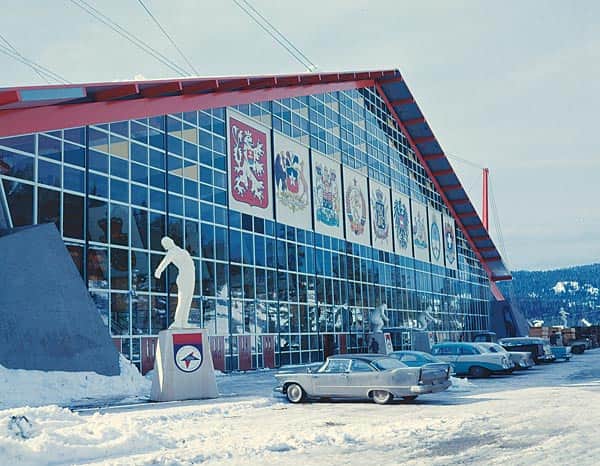
Blyth Arena during the 1960 Winter Olympics.
When Sunnyside sold in 1972, Briner ended his career as a supervisor and became the Deputy Director in Gov. Ronald Reagan’s California Department of Parks and Recreation. He still lived most of the time in Tahoe and commuted by plane to a second home in Alta Sierra. After three years, he returned to Lake Tahoe full time and became the general manager for the Tahoe City Public Utility District for an 8-year stint (becoming the third manager and the third man named Bill to hold the position).
“We were 2 million in debt. I managed to get it out of debt and have a reserve,” he said.
The State of California wasn’t done with Briner yet, however. In 1983, Gov. George Deukmejian appointed him to the task of managing California’s 246 state parks as the Director of State Parks. Briner faced the daunting task of maintaining and improving California’s enormously popular parks with not enough money to do so. Briner says it was “tough and very complicated. You try to run it like a business, but you can’t do that in California.”
He remained director until 1986, spending part of the time in a Sacramento apartment, but returning when possible to the family home in Talmont Estates where he and his family have lived since 1970.
While he set out to retire after his adventures in Sacramento, Briner says that he’s not good at not being involved.
“He has been a problem solver here in Tahoe … if something was wrong they would say ‘Bill, come fix it’,” said his wife, Fritzi.
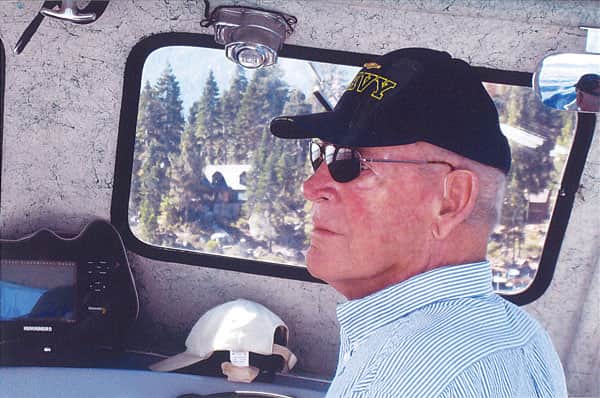 He ran the North Tahoe Chamber of Commerce, was one of the founders of The Truckee Tahoe Community Foundation and also helped to start the Tahoe Maritime Museum, which he also ran for a while.
While skiing is Briner’s winter passion, in the summer it is sailboats. He was active in the Tahoe Yacht Club, and served as its commodore in 1981. When a board member recently passed away, Briner agreed to jump in and take his place temporarily. It’s all part of his style of filling whatever vacuum in leadership pops up in front of him.
Antonucci calls Briner the “quintessential Mr. North Lake Tahoe. A man of many talents: Accomplished photographer, sailor, business operator and public official who always thought less about himself and more about the public good.”
Photos courtes Bill Briner


