


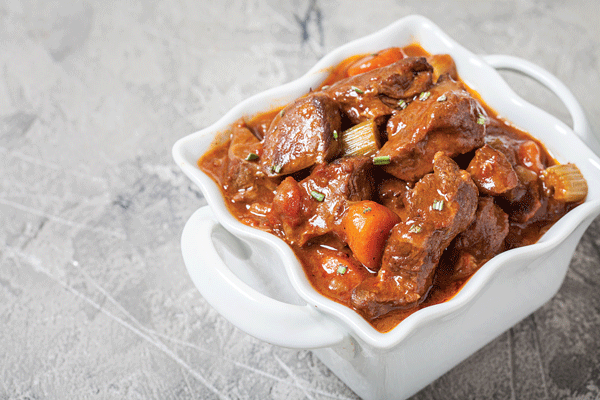
Usually during this time of year, stews and casseroles become great meal choices because of how hearty they are on a cold winter night. Stew is, after all, the quintessential comfort food and winter is the peak season for a nice big bowl of it.
A good stew is inexpensive and can be made in batches to last a few days or frozen for a few meals in the next month or two. Stew meat is not as costly as the choicer cuts of New York strip or rib-eye, but because of the braising process, the chunks can still become so tender they melt in your mouth. Along with the potatoes, carrots, celery, onions and whatever other veggies you want to add, you can easily get up to five meals for less than $20.
Stew is, after all, the quintessential comfort food and winter is the peak season for a nice big bowl of it.
A lot of people ask me what the difference is between a stew and a casserole. There is really not that much difference. They are both made similarly with the meat being browned, the veggies sautéed and the liquid added to finish the cooking. Technically, I think a casserole is usually baked in the oven in a single deep dish. It is the dish that gives it its name. A stew or a soup is usually cooked on the stove top. If you notice, I said usually. This is because when I think of a stew or a soup, the broth in a stew is much thicker. Anytime you have a thick broth, it becomes much easier to burn over direct heat when the pot is sitting on the open flame. This means you have to watch it more closely and stir it often because once the bottom of the pot burns, the burnt flavor is almost impossible to get rid of.
Any time you are going to stir a stew, chowder or other item with a thick liquid, start by gently using the rounded bottom of the ladle to see that nothing is stuck on the bottom of the pot. If there is nothing stuck, then stir it well so nothing stays on the bottom too long.
If there are chunks stuck to the bottom that is the first sign there may be something burning down there. Still using the bottom of the ladle, give it a little prod to see if it will easily break free. If it does, bring the ladle straight up and give it a taste just to be sure. If the chunk won’t budge, it is probably burnt. Avoid scraping at all costs.
Sample the top layer and slowly ladle the stew into another pot from the top, being careful not to stir it up. As you make your way to the bottom, sample more frequently and stop if you start to taste the burnt flavor.
Once the stew is burnt, there isn’t much you can do to save it. If it isn’t too bad, you can mask it a little with fresh lemon. Although it is not one of the normal ingredients, lemon can actually go better in stew than you think. Lemon also is good to add to something that has a little too much salt. Like with any seasoning, the quantity used is important.
Using a pot or pan that fits in the oven will allow you less chance to burn and also cut down on how often you stir it. You do still want to stir once in a while, but since the stew is getting its heat from all around and not just one spot it will cook more evenly. Whether you call it a soup or a stew or you cook it on the stove top or in the oven, make a big enough batch for a few meals and enjoy.
Beef Stew
2 lbs. stew meat, 2-inch cubes
5-6 red potatoes, large even chunks
2-3 carrots, sliced thick
1 large yellow onion, diced large
3 celery stalks, sliced thick
2 cloves garlic, diced
½ package frozen sweet corn
2 cans beef broth
2 T vegetable oil
4 bay leaves
2 rosemary sprigs
4 thyme sprigs
Salt and pepper, to taste
Tie the rosemary and thyme sprigs together with twine. Boil the potatoes in a separate pot until cooked, but firm, and immediately cool under cold water.
Get the pot hot on the stove. Brown the meat on all sides in 1 tablespoon of the oil. Remove the meat and add the other tablespoon of oil to sauté the onion, carrots, celery and garlic.
Add all the ingredients, season with a little salt and pepper and simmer for 1 hour, stirring often. Or, place the pot in a 350-degree F oven for 1 hour, stirring occasionally.
Remove the bay leaves and sprigs, add more salt and pepper to taste, if needed before serving. Note that the meat will become more tender when you reheat it.


