


Bold visions of instant wealth inspired the California Gold Rush in the early 1850s. For nearly a decade, tens of thousands of intrepid argonauts inundated the Sierra Nevada foothills searching for treasure. A few lucky miners achieved the dream; the rest endured months or years trying to survive in the miserable mining camps pitched along river ravines of the Sierra west slope. A high demand for food, mail and mining equipment encouraged small independent stagecoach lines to proliferate. The dense population and unusual prosperity enabled transportation to flourish without government aid.
He aimed a swinging blow with his buckskin lash at the near-wheel horse and in
the same movement brandished a heavy
dragoon revolver.
The commercial stagecoach business got its start in California when one entrepreneur hitched a spirited team of mustangs behind a secondhand French carriage and offered passenger service between San Francisco and San José. Soon, other staging operations sprouted up in Sacramento and Stockton, the gateways to the Mother Lode country. By 1853, a dozen small lines were fighting for business. The following year the competing stagers merged and formed the California Stage Company. Under the tight reins of company president James Birch, the enterprise soon controlled most of the staging business in the mining country of Northern California. It wasn’t long before it expanded into Southern California and Oregon, eventually operating 2,690 miles of stage routes in all.
Snowbound! Legendary Winters of the Tahoe Sierra talk
May 19 | 5 p.m.
Donner Memorial State Park Visitor Center | Donner Lake
The lucrative stage lines were immediately challenged by the “express business.” It didn’t take a financial genius to see that miners who would shell out $1 for a fresh apple would pay exorbitant rates to safely and quickly transport their gold or to receive cherished letters from home. The first to capitalize on the miner’s social isolation was Alexander Todd. In 1849, he appeared at the mining camp of Jacksonville where he offered to deliver letters to or from San Francisco for one ounce of gold dust or about $16 per letter. Communication with their loved ones was worth more than that to the lonely 49ers and Todd was besieged with business. The fat profit margin lured others into the trade until there were nearly 40 similar one-man operations scattered throughout the Sierra.
Merger mania eventually swept the express business, too. A large eastern conglomerate, Adams & Company, soon absorbed the hodgepodge of small-time couriers. For a while, Adams & Co. seemed destined to monopolize California expressing. It probably would have if Wells Fargo & Company, the western branch of the powerful American Express Company, hadn’t joined in the fray. American Express played hardball from the first, ruthlessly cutting prices and quickly challenging its opponent for control of the routes. The competition was cutthroat and by 1855 Adams & Co. was bankrupt. From that time on, Wells Fargo dominated the western express business.
New roads were constructed and old ones improved so that heavy loads of merchandise and bullion could be transported efficiently throughout the mountains. Two toll roads were built across the Sierra: the Placerville (State Route 50) and the Dutch Flat-Donner Lake route (Interstate 80). The toll roads were wide enough so that teams could pass each other.
Water wagons put down the dust and the roads were packed fairly smooth. The stages ran with exacting regularity and all business was conducted with promptness and professionalism.
Wells Fargo employees executed their responsibilities with the confidence associated with a well-run, profit-earning business. But there were plenty of frustrated down-on-their-luck miners, drifters and miscreants who coveted the Wells Fargo money box. Grim and determined, few road agents were killers; it was the gold bullion or coins they were after. An article in the Nevada State Journal described a typical robbery: “The men [bandits] were armed with revolvers and made no attempt to molest the passengers, eight in number, but when one or two of them put their heads out of the window they were ordered to take them in or they would have them blown off.”
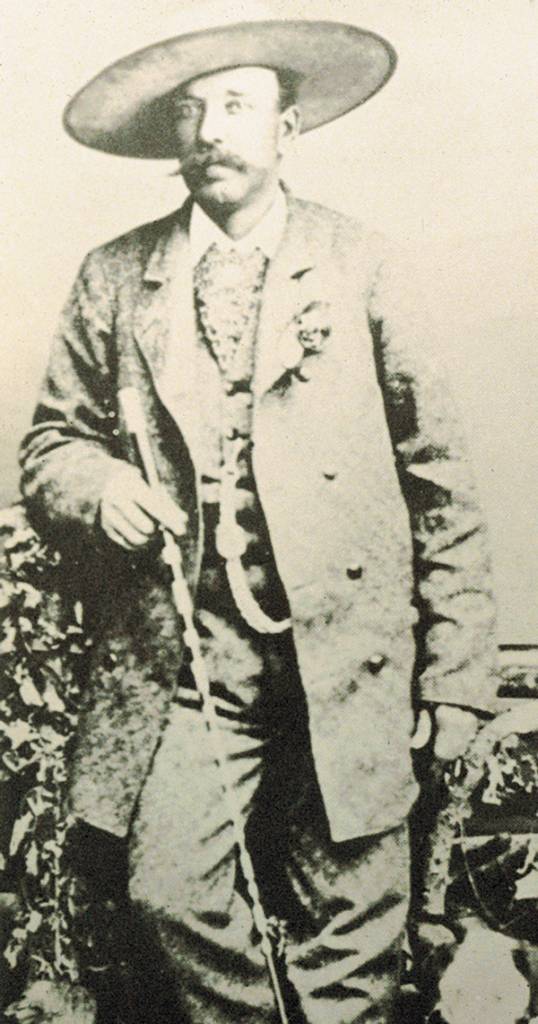
Popular western stagecoach drivers had a style all their own. One of the most colorful was the celebrated fashionista Jim Miller. Even in an occupation notable for embroidered overcoats and flashy accessories, Miller’s ostentatious style stood out. His hats were the widest Mormon wide-brims available, his ascot tie held in place by stick pins as large as a lady’s brooch and his whip stock bound with bands of pure gold. Miller had started out as a stager based in Virginia City, Nev., but when Comstock mining production hit a lull, he started another company in the White Pine region of Nevada.
Before Wells Fargo began adding armed guards, the stage driver was the only defense against attempted robbery. On one run in the mid-1860s, Miller set out with five passengers and $30,000 in minted gold for a mining payroll. As the stage slowed on a steep grade, the feared “Halt!” and a command to “Throw down the box!” growled from the tawny twilight. Miller recognized the danger and reacted without hesitation. He aimed a swinging blow with his buckskin lash at the near-wheel horse and in the same movement brandished a heavy dragoon revolver. Miller pulled the trigger and the dragoon roared like a cannon.
The Concord Coach rocked back and forth on its springs as the horses bolted, which may have helped everyone survive withering gunfire from bandits hidden in a ditch alongside the road. Bullets splintered the expensive enamel painting on the coach door as the passengers cowered on the floor, guzzling the last of the evening’s rum. Miller’s quick action saved the day and the stage thundered off into the darkness with the Wells Fargo treasure and passengers intact.
When word of Miller’s bravery reached Wells Fargo’s headquarters in San Francisco, the company announced that it would award him “the biggest bullion pocket watch and chain ever made.” Noted San Francisco watchmaker J.W. Tucker crafted the timepiece from a 4-pound bar of pure gold bullion. Fellow artisans forged a complementary watch chain. Together they produced a striking masterpiece.
Comstock newspaperman Alf Doten described it well in his 1866 journal: “Saw Jim Miller’s watch and chain today, all of solid Washoe Bullion. Watch and chain weighs four and a half pounds, the watch alone weighs 22 ½ ounces. It has Miller’s name with a coach and eight horses engraved on the outside of one of the cases.” It was the largest and heaviest watch and chain ever seen in the West. For the rest of his career, Dandy Jim Miller wore it with pride — and deservedly so.


