


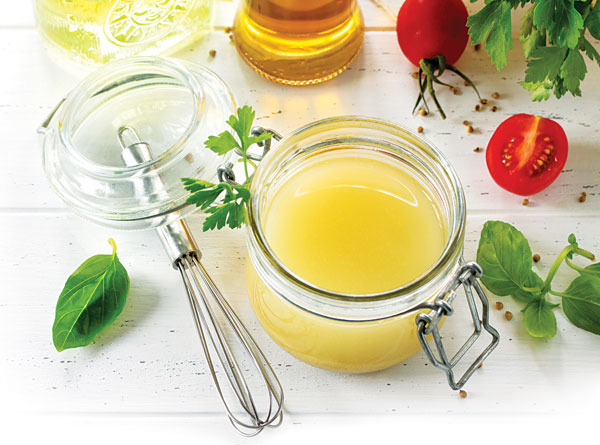
I’m not sure how many of you noticed the list of popular ingredients in the Aug. 2 issue when I was talking about marinades, but if you look again, you will notice they are almost identical to vinaigrette.
Try Chef Smitty’s Marinades
When you look at vinaigrette and a marinade side by side, there is not a lot of difference. Most of the difference would be in the ratio of the ingredients as opposed to the ingredients themselves. It is common to use vinaigrette for a marinade and whatever is being cooked will come out great. Probably the biggest difference is the ratio of oil to vinegar. Vinaigrette oil-to-vinegar ratio is usually around 3 to 1, while a marinade will often be closer to 1 to 1, or with even less oil.
Another thing to consider when making vinaigrette is if you want an emulsified dressing, in which the ingredients are separated until the time of use, then mixed together. A classic Italian dressing is a great example. When you look at the bottle, you will see the various layers and ingredients. Emulsified vinaigrette is more of a creamy dressing with all the ingredients bonded together. An example of this would be creamy Italian.
Just as in soups, a dressing that is creamy, doesn’t mean there is cream in it. There are a few ways to get this emulsification. In my marinade article, I mentioned mustard and how you can substitute chili paste or some other ingredient to get the zip provided by the mustard. In a dressing, the mustard also helps bond the oil to the other ingredients. Another way to get an emulsification is to use an egg yolk. You don’t have to worry about the egg being raw because it will cook in the mixing process with the acid of the vinegar or citrus. You also can get that emulsification for a short period with almost any dressing with a vigorous shaking. If you want a true emulsification though, add the oil slowly to the mixed ingredients using a blender or at least hand whisking rapidly.
As for the rest of the ingredients, there will usually be a little garlic, herbs and spices, salt and pepper and some type of sweetener. There also can be various nuts and fruits. All of these things are going to end up on your salad so think about what flavors you are in the mood for and pick the ingredients you like.
Vinaigrettes will also keep in the refrigerator for a while because oil and vinegar are great natural preservatives. You can make different types of dressing, so you don’t wear your taste buds out on one kind, day after day. Also, try to match your ingredients to their own strengths. If you are making a fruity dressing, use raspberry vinegar or other lighter vinegars and lighter herbs. I like sweet basil because it won’t mask the lighter flavors of the fruit. I’ll use thyme and other stronger herbs with balsamic or bolder dressings. You also can use various oils for different flavors.
One of the more interesting ways to change around the flavors is with the sweetener. I love to use various fruit juice concentrates, honey and — my favorite sweetener — maple syrup. The juice concentrate should be added as one of the first ingredients because you will need to be sure the dressing reaches the proper consistency when adding the oil. You can add a little more later to taste as you play with the final product. The thicker sweeteners can be slowly added toward the end to taste.
Here is a vinaigrette that is a type of French dressing that has no sweetener. You can try changing it a little by adding maple syrup near the end of the blending process. With all this in mind, try experimenting with your vinaigrette and enjoy your dinner salad.
Vinaigrette
3 C vegetable oil
¼ C white vinegar
1 egg yolk
1½ T Dijon
2 t curry powder
Salt & pepper to taste
Place half the curry and all the other ingredients except the salt and pepper and oil in a blender. Slowly add the oil. If the dressing gets too thick, add a little water and maple syrup, if desired, and continue until all at least most of the oil is used — all the oil if using maple syrup. Add more curry, salt and pepper to taste.


