


Editor’s Note: This is the second part in a series covering the tourism impacts that locals and visitors alike have experienced this summer. Read more in the series:
Part I, “Tahoe’s tourism tipping point,”
Part III, “Trash kills bears.”
Part IV, “Microplastics: Tahoe’s tiniest trash,”
and Part V “Fire, fear & red flags.”
Read the February 2021 followup to the original series:
“Tahoe’s trash trouble continues.”
It only takes 110 steps from the end of my driveway to the small entryway to Donner Memorial State Park at the east end of Donner Lake. In the stretch of fewer than three-tenths of a mile on any given day, I collect an entire bag of garbage, most of it on the road.
One evening I collected one yellow bathing suit top, five beer bottles, 10 beer cans, three disposable face masks, cigarette butts, napkins, tissues, an empty La Croix box, a windshield wiper and a trailer license plate. As I enter into the park, several signs from the Tahoe Fund mask campaign lie askew on the ground. Several bags of dog poop are stacked neatly in a pile in front of the signs. Behind the gate, more beer cans and a piece of Styrofoam. Once on the trail, I collected two pairs of children’s underwear, a small blue T-shirt, random pieces of paper and wrappers, half of an onion and a lot of toilet paper in the bushes only a few hundred yards from the portable toilets.
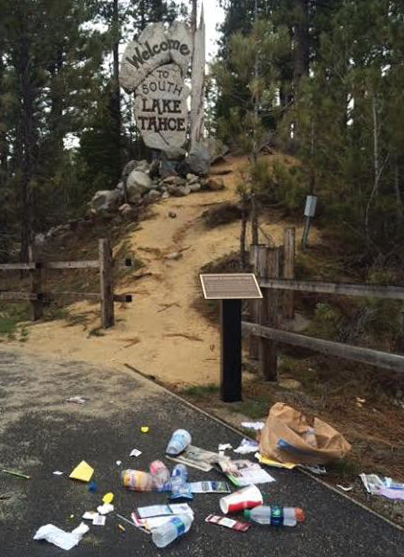
Mine is only one of the hundreds of stories plaguing the Tahoe Sierra. The lakes, rivers and trails of Tahoe have become dumping grounds for the unconscious, lazy and unaware. If it’s not couches being dumped in the woods, overflowing Dumpsters or people leaving trash just about any place you can think of, then it’s an increased level of graffiti marring the boulders, train tunnels and signs. Garbage this summer has caused the community a lot of grief.
The Tahoe Sierra is being trashed, but this isn’t a new problem in our community. This year it has been exacerbated by the pandemic and the sheer amount of people in the region, as local officials discussed in the first part of our series “Tahoe’s tourism tipping point” available at TheTahoeWeekly.com.
Locals in Tahoe are fed up and frustrated as garbage and graffiti have taken center stage in this pristine mountain region.
“Even before COVID, litter has been a major issue and has gone unchecked and has led us to where we are now,” says Court Leve, who founded Truckee Tahoe Litter Group on Facebook. “By ignoring the problem, it’s grown out of control. Have you ever seen anyone ‘educating’ or doing ‘positive messaging’ in your travels? Maybe at the entrance to a national park. And, do we really need to educate people on littering? Isn’t that something we learn in kindergarten? People respond to punishment. Speeding tickets work. DUIs work. Why the hesitancy of punishing people for destroying the environment?”
One potential upside is the that issue of trash this summer in Tahoe has received a lot of press across California and Nevada. Community members have banded together frustrated by the sheer amount of litter that has besieged the area. I asked Leve if he thinks the press and public outcry has made a difference.
“Yes. It’s all coming to a head. I think this has been similar from South Lake Tahoe to Truckee and all around the Lake. Truckee Vice Mayor Anna Klovstad said the town is going to field calls regarding litter,” says Leve, who has been vocal about the lack of action from officials.
But, he also says it’s frustrating because of the complicated nature of who is responsible for cleaning up public lands in the region.
“You call one agency or government official and they say it isn’t their jurisdiction to deal with the litter problem,” Leve says.

Whose job is it?
Placer County, Nevada County and Town of Truckee have come under heavy fire recently from residents for not taking more responsibility for the issues of garbage mitigation and its impact on the region. These include not enough garbage receptacles or garbage pickup, not enough portable toilets, not enough parking, not enough education and not enough dollars being allocated to alleviate the problems.
One of the biggest challenges when it comes to cleaning up trash and solving the many issues in the Tahoe Sierra is dealing with a plethora of agencies. Public lands throughout the region are owned and managed by a myriad of agencies and organizations, which includes five counties – Placer, Nevada, Eldorado, Douglas and Washoe — along with the City of South Lake Tahoe, the City of Carson City and Town of Truckee. Add to that agencies such as the U.S. Forest Service, California and Nevada state parks, public works districts and nonprofit organizations, among others, that all need to work together.
Among the many complaints from locals is that the section of the Truckee River between Tahoe City and Alpine Meadows were thousands of people float the river each summer is plagued with human feces, diapers and toilet paper. On any day, hoarders of rafters float the river looking for respite from the heat, but almost none of them are practicing physical distancing or wearing masks when near others and the river is being trashed. So, who is responsible for cleaning up this stretch of the Truckee River?
“It’s the U.S. Forest Service’s responsibility. There are Porta Potties that are put out by the commercial rafting companies; they’re mandated to pay for that service. [Placer] County does not regulate the river,” says Cindy Gustafson, the 5th District supervisor for Placer County. Her district stretches from Auburn to the shores of Lake Tahoe.
“The Forest Service is the entity that owns most of the access in and out of the river. Caltrans also has the right of way along the river, so it’s not a county function. But we do mandate that the commercial operators provide certain requirements,” says Gustafson. This includes removing trash and providing public toilets and parking for its customers.
The same issue is echoed at Donner Lake in Truckee where the lake falls within the boundaries of Town of Truckee, but the town is not responsible for garbage. Rather that falls under a separate agency, Truckee-Donner Recreation & Parks District, says Truckee Mayor Dave Polivy. He noted that the town works with at least 16 agencies and organizations to tackle different services and functions.
“The garbage and usage issue has not gone unnoticed by us at TDRPD. We are currently working on solutions to keep the cleanliness and quality of our piers,” says Kyle Jost, marketing manager of Truckee-Donner Recreation & Park District. “Our maintenance staff is making a point to increase rounds along the piers to clean and inspect for the rest of the summer.”
The district manages the public boat ramp, the 37 public piers around the lake, Shoreline Park and West End Beach. Jost also said that the district is also looking at solutions to address the garbage in the off-season.
Lack of enforcement
Through Truckee Tahoe Litter Group, more than 2,000 members have been voicing concerns and posting photos of garbage, graffiti and wildlife eating garbage — they have also been expressing fire concerns. It has also become a place to post information about local cleanup efforts. And, members have been calling for more enforcement of litter laws.
“We should be a model. Truckee-Tahoe should be the example for the world on stewardship,” says Leve, but he adds that local officials don’t make it easy to report or complain about what to do with the garbage.
There is a $1,000 litter fine in California, but many locals do not see this being enforced and are demanding more stringent enforcement. But it is an issue of having to catch someone red-handed dumping or leaving litter, say local law enforcement.
I reached out to Truckee Police, City of South Lake Police Department and Placer County Sheriff’s Office to discuss litter enforcement efforts.
Lt. Michelle Baxter, with Placer County Sheriff’s Office, acknowledged that garbage is an issue but that a deputy has to catch someone in the act to issue a citation. She said that deputies cannot issue a citation based on a report by a member of the public. She added that the department doesn’t have the manpower nor the budget to patrol for litterers and their deputies and detectives have other priorities. She noted that there’s been an increase in vehicle break-ins and bike thefts this summer with more people in the area.
Deverie Acuff, support services manager for Truckee Police, responded by email stating that they have issued 17 litter citations in the past two months — most along Donner Pass Road.
The summer of single-use
Many agencies and officials attribute the increase in the amount of garbage to the increase of more single-use containers due to COVID-19 safety protocols.
“We have a lot of people coming to Lake Tahoe, especially now during the pandemic. We also are seeing an increase in single-use of packaging and to-go stuff,” says Marilee Movius, community engagement manager for the League to Save Lake Tahoe.
The league has been hosting a July 5th beach cleanup each year and has been collecting data since 2013.
“The same number of litter items are collected during cleanups, but we’re seeing a lot smaller trash and less heavy stuff. And 30 percent of all the litter we collected from the cleanup this year was plastic,” says Movius.
The Tahoe City Public Utility District (TCPUD) manages public beaches and the paved multiuse trails from Olympic Valley to Tahoe City and along a large portion of the West Shore and says it is also working on solutions for garbage and sees single-use containers as an issue.
“Agencies are managing parks and facilities and yet we see the increase in trash. We know where the trash is coming from: a lot of it’s coming from to-go containers,” says Valli Murnane, director of TCPUD Parks and Recreation. “We are just trying to stack our shifts, increase our rounds on trash. It’s such a different year for us. What’s very noticeable in the parks department is this is something we’ve never seen before: this volume of people and this amount of trash.”
Jeanette Tillman, sustainability coordinator for South Tahoe Refuse & Recycling Services, loves to talk trash. She acknowledges there’s a lot more garbage being picked up and the impact on the environment and wildlife is paramount.
“Historically, we are able to recover from peak holidays and weekends where we see increases in the garbage. On average, we see about 275 tons of garbage per day that we take to the transfer station. We are seeing 75 tons more than normal from last year to this year on average. It’s a 30 percent increase in garbage,” says Tillman.
The goal, says Tillman, is to try to mitigate some of the garbage issues and South Lake Refuse has put out additional Dumpsters free of charge to help deal with the increased garbage level.
“Even with the increases, we’re still seeing people are illegally dumping,” she says. “People generate approximately 5 pounds of garbage a day each, on average. As human beings, we need to take responsibility for that garbage. It’s pretty simple, really. The No. 1 rule is to reduce, the No. 2 rule is if you can’t reduce, then reuse, and if that’s not possible, recycle. Disposable masks are not recyclable and are going directly to the landfill. Choose a reusable mask,” says Tillman, who also hosts the “Trash Talk Podcast” on Spreaker.
Both Tahoe Truckee Sierra Disposal, which collects garbage in Placer County and Truckee,
and Waste Management, which collects garbage in Washoe County, say they’ve seen a decrease in commercial trash but an increase in residential trash and in public places like campgrounds.
California State Parks have also been bombarded by increased levels in trash and have reported that they have spent $400,000 in garbage removal this summer at local parks.
“We’ve seen a significant increase in residential garbage and garbage in campgrounds,” says Kelli Hare, operations and office manager of Tahoe Truckee Sierra Disposal. “Most of the campground hosts and rangers call us to say they’ve never seen activity like this before. And that’s incredible because we’re a tourist area.”
Another issue is that when garbage isn’t secured or is left outside a Dumpster, it attracts wildlife.
“People don’t realize that they’re supposed to keep their trash contained and they’re putting just loose trash right next to bear boxes,” says Hare.
Local groups take action
The League to Save Lake Tahoe is looking to advocate for solutions and to get people involved. In partnership with UC Davis Tahoe Environment Research Center (TERC) and Desert Research Institute (DRI), they introduced the Citizen Science Tahoe app that can be used to report litter among other issues. Locals, visitors and organizations can see what’s going on at Lake Tahoe and share that information with organizations to develop solutions.
“The app can be used to report litter and trash along with other things that you can report like aquatic invasive species, stormwater runoff or algae,” says Movius.
Colin West, the founder and executive director of the environmental nonprofit Clean Up the Lake, has spearheaded efforts to clean up the waters of Lake Tahoe and Donner Lake using scuba divers. West and his volunteers have collected 3,700 pounds on the north shore of Donner Lake and more than 1,000 pounds out of Lake Tahoe.
“Some of the stuff is decades old. We pulled up old whitewall tires, boomboxes, tapes, shoes and fishhooks,” says West, who adds that the pandemic and the weather thwarted his initial plans for a 72-mile cleanup of Lake Tahoe, which will now occur next year.
“We’re going to go back and finish circumnavigating Donner Lake. The community in Truckee came out in an amazing way and we surpassed our goal on a GoFundMe to clean up Donner Lake and get signs on the public piers. It’s a partnership with Ella Hoyer, a 12-year-old girl,” says West, who wants to help youth understand the impact of garbage on the environment.
The organization will also be releasing a short film about Donner Lake and is working with TERC and DRI to analyze the trash.
These are just a few of the many locals and nonprofits that have stepped up to clean up the region, but there are still many unanswered questions of how to come up with short-term and long-term solutions.
“We really believe that people should be the change we want to see in the world and sharing those good examples will be a positive change for others,” says Movius.
Connect & report
Citizen Science App | citizensciencetahoe.org
Clean Up the Lake | cleanupthelake.org
The League to Save Lake Tahoe | keeptahoeblue.org
Tahoe In Balance on Facebook
Tahoe Truckee Litter Group on Facebook
El Dorado County
Eastern Slope area | (530 573-3450, edcgov.us
Douglas County
Code Enforcement Office | (775) 782-6214, douglascountynv.gov
Nevada County
Illegal dumping | (530) 265-7111, mynevadacounty.com
Placer County
Garbage complaints | (530) 581-6240, placer.ca.gov
Tahoe Truckee Sierra Disposal | (530) 583-7800, waste101.com
South Lake Tahoe
City of South Lake Tahoe | (530) 542-6000, cityofslt.us
South Tahoe Refuse | (530) 541-5105, southtahoerefuse.com
Clean Tahoe Program | (530) 544-4210, clean-tahoe.org
Truckee
Town of Truckee Trash complaints | recycle@townoftruckee.com
Keep Truckee Green | (530) 582-7700, keeptruckeegreen.org
Truckee-Donner Recreation & Parks District | (530) 582-7720, tdrpd.org
Washoe County
Garbage complaints | (775) 328-6106, washoecounty.us


