


The scent of baking bread entices a rumble in the stomach. The yeasty aroma of warm sourdough, the earthy smell of whole wheat or a warm slice of focaccia can seduce the senses. Each culture has its rendition or version of bread, whether it be ciabatta or chapati, naan or arepa, roti or rolls. The list of breads from around the world is long. Matzo, tortillas and hardtack are often considered types of bread.
“We always had sourdough starter in our house. Although my dad sometimes found it in the back of the fridge and thought it was bad and threw it out occasionally.”-Molly Knickerbocker
The term “breaking bread”’ initially referred to the Eucharist, but in this day and age, it often signifies a coming together to share a meal.
Baking bread for some of us can be completely intimidating. While many of us are novice bread bakers, my first couple of sourdough attempts were somewhat disastrous and a bit hilarious. The first loaf I made produced a dense and heavy loaf, which was slightly brick-like, although it tasted pretty good.
In my second attempt — which I equate to my Philly roots — my loaf ended up more like a soft pretzel rather than a well-balanced sourdough. It was doughy on the inside and crusty on the outside. And yes, the best soft pretzels are from Philadelphia.
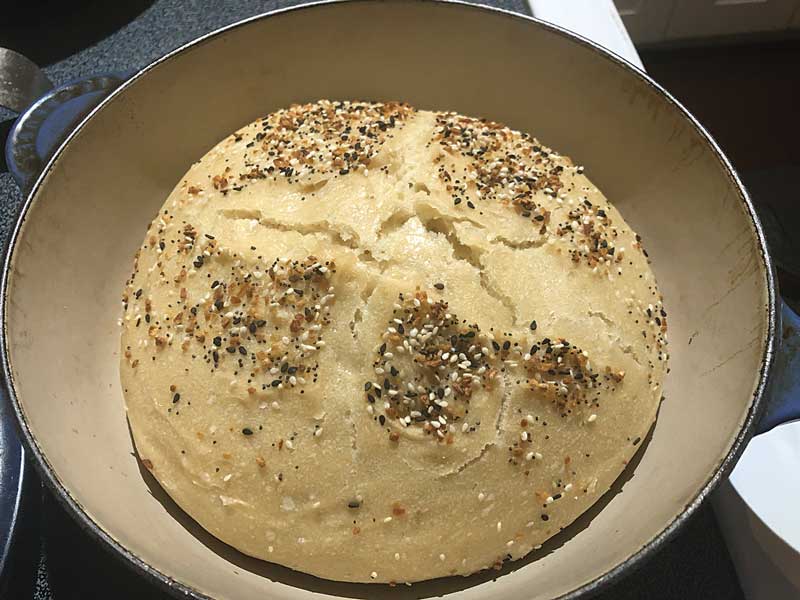
It was only after numerous attempts that I finally acquired a near-perfect loaf, crusty on the outside, yeasty and flavorful on the inside with a slight tang. I added seeds to the top, which afforded me a bit of my New York upbringing, which was an ode to the everything bagel. And yes, in my opinion, New York has the best bagels in the world — and pizza, too.
Since the pandemic’s start, it seemed as if everyone became a bread baker, myself included. My friend, Molly Knickerbocker is a baker. She has patience and precision when it comes to her craft — so much so, she started her bread business while sheltering in place.
I asked Molly what the secret is to a good loaf of homemade sourdough bread? Her response was: “Time. A good loaf of sourdough has a thick crust with a good caramelization and the right number of pockets of bubbles — varied and not too tight.”
A good sourdough begins with a sourdough starter.
“I got my starter about seven years ago from a friend who was working in a bakery in Santa Cruz. The sourdough starter was around 13 years old then. At the time, I was living in a small place with limited kitchen space and only had a convection toaster oven. I made crackers, pancakes, waffles and pizza with my starter,” Molly says.
She learned to bake bread with her mother. They made loaves for church functions and their neighbors.
“We always had sourdough starter in our house. Although my dad sometimes found it in the back of the fridge and thought it was bad and threw it out occasionally. The starter can sometimes form a liquid alcohol layer that can appear to make it funky. Some sourdough starters can be very old and handed down from family members,” she says.
Feeding your starter is imperative to keeping it well and healthy.
“If I keep my starter out on the counter, I try to feed it every day. If I store it in the fridge, I try to feed it at least once a week,” she says, explaining that she feeds the starter by adding more flour and water.
“When you bake sourdough, you want pockets and elasticity in your bread. It gives sourdough a light, airy and delicious flavor. Growing up near San Francisco, I love my sourdough sour,” she says.
She got serious about baking bread about two and a half years ago, who uses a no-knead method to bake: “I use a bulk fermentation process, let it rise, then shape the loaves and let it rise again before baking.”
For those who just want the fruits of another baker’s labor and don’t want to undertake the art of breadmaking at home, there are many bakers and bakeries that make delicious sourdough bread in the Tahoe Sierra.
Easy Sourdough Bread | From the kitchen of Priya Hutner
3 C of flour
1¼ C warm water
1½ t salt
¾ C sourdough starter
¼ C mixed everything seeds (optional)
Mix flour and salt in a large glass bowl. In separate bowl, mix water and starter and add to flour. Mix well with hands. The dough should be a bit sticky. Transfer into an oiled glass bowl and cover with a damp cloth and let it rest for 3 to 6 hours until it rises.
Fold and turn the dough, rest seam side up and let it rise for another 30 to 60 minutes. Preheat the oven to 450 degrees F.
Place cornmeal on the bottom of Dutch oven or use a glass loaf pan with lid and place shaped dough in pan. Add seeds and score the top of the dough down the middle. Cover and bake bread for 20 minutes. Remove lid and bake another 10 minutes.
For a crispier crust, remove bread from Dutch oven and place directly on the oven rack for an additional 8 to 10 minutes. Check for doneness with a thermometer that should read 210 degrees F. Let cool and enjoy.


