


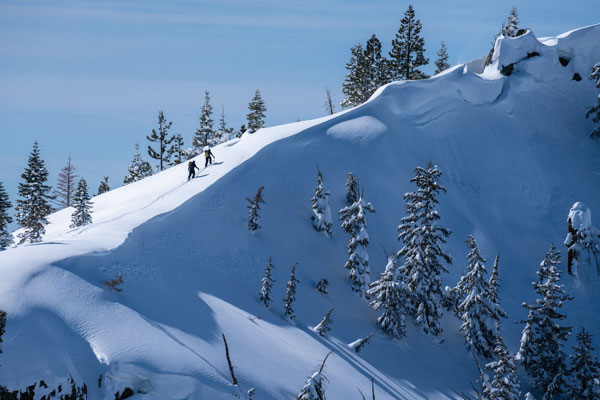
Make no doubt about it: the crowds are coming to an avalanche zone near you.
Over the past decade, back-country skiing has been the fastest growing winter sport in the Tahoe Sierra. In 2021, its popularity is expected to surge like never before.
With ski resorts operating at limited capacity and the uncertainty of what other changes the pandemic may bring this year, more outdoor enthusiasts are turning to the freedom and flexibility of our public lands.
Read our “Back country 101” guide
“With the current Covid situation, we are going to see an increase of people in the back country,” says Tahoe Backcountry Alliance executive director Greg Garrison. “We expect an onslaught of new users and we are working with a number of partners to get ahead of the curve to make sure everyone is safe, courteous and kind as they ski.”
“We are concerned there are people going into the back country who are not avalanche educated, who are not familiar with their equipment, who have not practiced. That would be concern No. 1; that we are going to see people get hurt or worse.” –Greg Garrison
A Ski Community Steps Up
As a voice of human-powered winter travel in the Tahoe Sierra, the Alliance has posted a back-country tips and etiquette guide on its website to remind skiers of some important concepts around education, safety and respect. After helping to organize the first Backcountry Safety Awareness Week in December, they are hoping to get the message out to hordes of first-time explorers who plan to visit the winter wilderness this year.
“We are concerned there are people going into the back country who are not avalanche educated, who are not familiar with their equipment, who have not practiced,” says Garrison. “That would be concern No. 1; that we are going to see people get hurt or worse.”
The Alliance has adding a “Report an Access Issue” button on the website for back-country users and land managers to relate problems in real time. Their biggest single message: be prepared, self-reliant and considerate.
In anticipation of the increased use of the back-country this season by first-timers, the Tahoe Weekly featured our guide “Back country 101: Training, gear essential to back-country travel” in the Dec. 16, 2020, edition, which is also available online.
“The responsibility is on the user to keep themselves safe while they are out there,” says Garrison. “Don’t posthole the skin track. Pick up your dog poop. When parking is not plowed, don’t park in the road. Get your shovel out and dig yourself a spot … It’s everyone’s responsibility make sure we are good stewards.”
Resources
AIARE courses | avtraining.org
Avalanche information & education | avalanche.org
Sierra Avalanche Training Center | sierraavalanchecenter.org
Sno-Park Permits | (916) 324-1222, ohv.parks.ca.gov
Tahoe Backcountry Alliance | tahoebackcountryalliance.org
Donner Lake Run access
With trailhead access an ever-present issue, the Alliance scored a big win this year by securing long-term parking for the iconic Donner Lake Run.
After negotiations with local homeowners associations, they partnered with Truckee-Donner Recreation and Park District to utilize the parking lot at West End Beach for winter access to the popular back-country route. The famous run begins on the Pacific Crest beyond the gates of Sugar Bowl Resort and ends in the neighborhood west of Donner Lake. For years, skiers parked illegally on nearby side streets, angering homeowners with concerns of trespassing, littering, blocking snow removal and increasing avalanche danger.
In return for a five-year winter lease of the established lot, the nonprofit Alliance has agreed to pay for snow plowing, pavement resurfacing and informational signage at an upfront cost of more than $30,000. The Donner Land Trust has assumed liability for parking and negotiated with private homeowners to lease an easement that provides entry and exit to the trailhead at the bottom of the run on Cottonwood Street.
While the lot is a half-mile walk from the trailhead, the Alliance sees this as a big step toward establishing the positive community relationships critical sustainable back-country access.
“I feel good about not adding new pavement and reusing an existing facility seems like an obvious choice,” says Garrison, who is also a civil engineer. “Getting access is step one, but that’s not the most important point. It’s that we form relationships to prove that back-country users are responsible. This is going to be a long-term effort.”
Last year, the Alliance piloted a microtransit program to experiment with ridesharing in the Tahoe Basin. The program, along with all in-person events, have been put on hold for 2021 due to the pandemic.
Its newest project is the installation of laser-technology trailhead counters at Castle Peak and Tamarack Peak, with plans to put in more later on.
“It will quantify users at the trailhead in order to demonstrate how important public lands are and how essential public assess is,” says Garrison. “Tahoe Rim Trail uses the same counters.”
The volunteer-driven Tahoe Backcountry Ski Patrol will download the stats on a monthly basis and maintain the counters throughout the changing snow cycle to ensure they are consistently placed at the correct height to collect data in relation to the snowpack.
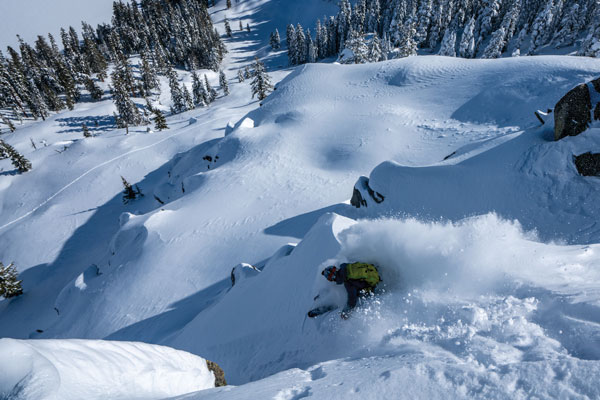
Guide Services Booming
While Zeb Blais was disappointed to see his Spring expeditions to Bolivia and Iceland cancelled due to coronavirus, he took the hiatus as opportunity to finally start his own business, Blackbird Mountain Guides.
So far, this winter has been a windfall.
“Last March we had a massive storm; the timing was perfectly in line with when Covid hit,” says Blais. “The snow was at its best when the ski areas completely shut down. People needed to figure out a way to keep skiing without the lifts running. The phones started ringing off the hook at guide services, gear rentals and retail shops, and basically everyone sold out of back-country gear.”
Local guides are now offering more avalanche training than ever before.
“It’s been pretty crazy,” says Blais. “People are booking months in advance. Things are selling out fast … As educators, we’re psyched to see the enthusiasm. We have great programs that provide people with the skills they need to recreate safely.”
Blais sees the uptick in interest as a positive trend for a U.S. guiding industry that has long lagged in comparison to Europe and other parts of the world.
“In the U.S., people are often opposed to hiring guides,” he says. “They would rather go on their own and learn from their mistakes. I hope people open up to the idea that hiring a guide can fast track learning back-country skills and it can be a lot more fun. It’s also less responsibility. You don’t have to plan, you just get to go out and have a great time.”
Like other area guiding services, Blackbird Mountain Guides offer American Institute for Avalanche Research and Education (AIARE) level one, level two and rescue practice courses, along with privately guided ski tours.
“It’s been shown through research that recreationalists don’t rescue their friends,” says Blais. “They often fail. They don’t have enough hours of practice to enact a rescue … This year it seems that most people are doing it right and are prioritizing getting the education they need before they get out in the field. The most important piece of gear in the back country is education.”
Emily Hargraves is the owner and self-proclaimed chief executive babe at Backcountry Babes, a Truckee-based guide company that offer courses for women in California, Colorado and a number of international locations. With coronavirus in mind, she’s made a few changes to her avalanche training program to keep people safe and streamline educational services.
Instead of groups of 12 with two guides, courses will run in groups of six with one guide, masked and socially distanced. Hargraves has also introduced online coursework with homework and Zoom meetings, rather than in-person classroom sessions.
“We tried to make it intentional to have a better teaching product, rather than just a Covid band aid,” she says. “It’s a more self-paced learning, which gives students time to take in the material.”
Hargraves sees the greatest issues facing back-country skiers this season as parking access, overcrowding and safety.
“People don’t want to carpool these days and they aren’t encouraged to,” she says. “We are encouraging skiers to double park in your partners … My biggest advice for the back-country season is to be kind. I think it’s going to be crowded and popular. It’s always nice to say hi to people at the trailhead, get info on conditions, be patient on the skin track and help each other stay safe out there.”
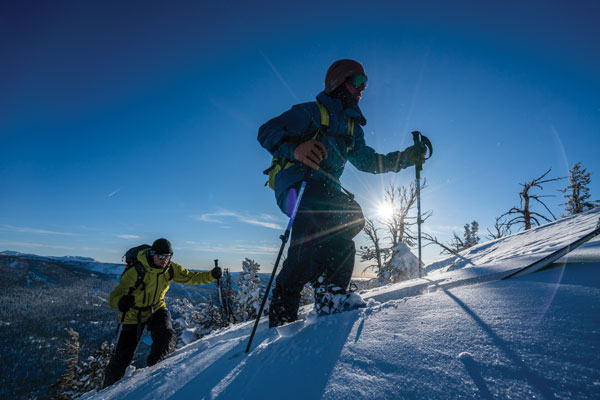
Nonprofits Skin Onward
When Tahoe Weekly spoke with Sierra Avalanche Center executive director David Reichel, he was on his way to Elephant’s Back on Carson Pass to examine a potentially persistent weak layer of faceted snow left over from early season storms.
The nonprofit he oversees is a collaboration with the U.S. Forest Service, which provides avalanche forecasting for the Tahoe Sierra on a daily basis. Much like Tahoe Backcountry Alliance, it is funded primarily through grants and donations. And in the current economic climate, their bottom line in suffering.
“We’re looking at about a 25 percent hit to our budget,” says Reichel.
Last year, the Center reached more than 2,000 people through shop talks, film festivals and other events. With everything cancelled, overall donations are down.
But the biggest hit to the Center’s approximately $360,000 operating budget is the loss of ski area day-pass donations. For the past decade, the Center has sold these passes as a way to generate revenue. However, under new California Covid protocols, ski resorts can no longer sell day-of passes to limit capacity.
“We’re burning some reserves to maintain the level of services because we anticipated a need for it this year,” says Reichel. “Hopefully, this is a one-time emergency and we’ll make that up for the future, so we don’t have to make cuts down the road.”
Thanks to an OHV grant from California State Parks, the Center will continue to offer free avalanche training specifically designed for motorized users such as snowmobilers.
“The way motorized users move through the mountains is different,” says Reichel. “We’re trying to meet the needs of the mechanized community.”
The trainings are first-come, first-serve and enrollment opens a month prior to each course.
As always, the Center’s No. 1 priority is providing the informational awareness for people to make good decisions in the mountains. From a scientific standpoint, Reichel believes there could be a statistical increase in human-triggered avalanches this year based on the anticipation of more users, especially those who are new to the back country.
“If there are x number of trigger points in the back country and we have more people than in the past, it stands to reason that it’s more likely we will find those triggers,” says Reichel. “In general, I would encourage people to check the forecast before you head out there. I’m a big fan of making my personal back-country skiing sustainable. Let’s enjoy it, but also take the long view.”
Trailhead Parking Guidelines
Courtesy Tahoe Backcountry Alliance
- Roadside parking is illegal & may result in ticketing and/or towing.
- Park off the road in approved parking areas only.
- Do not park in areas that have not yet been plowed.
- If your preferred destination trailhead is full, please head elsewhere.
- Do not park in homeowners’ driveways regardless of the current occupancy situation.
- Just because other people are parking there doesn’t mean it’s legal.
- Permits are required at California Sno-Park & must be purchased in advance.
- Be courteous.
Trailhead Parking Conditions
Courtesy Tahoe Backcountry Alliance
Rubicon Peak | There is no legal parking to access Rubicon Peak. Back-country skiers are being ticketed aggressively.
Ward Canyon | There is no confirmed legal parking to access public lands from the Ward Canyon trailhead.
Donner Summit/Castle Peak | The only legal parking for the Castle Peak area is at the Sno-Park location.
West Bound I-80 Rest Area | The Rest Area is patrolled by CHP and they are enforcing the “No Snow Play” parking rules.


