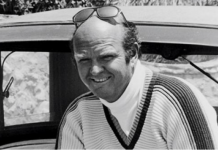
In the Sun Valley Opera House in November of 1950, 13 people paid $1 to see my first feature-length ski film, “Deep and Light.” That meant that there were 337 empty seats. My income for the evening was 40 percent of that $13 or $4.20.
After the show that night, I learned a couple of important lessons from the theater manager that I have never forgotten: 1) Entertain the people that show up and feel sorry for the people who did not and assume that they had not heard about the showing of the film, and 2) You will work all of your life to be a success overnight.
Since I have not worked my entire life yet, this lack of success is apparent as I am still writing my biography.
Every time I think I am finished I discover a note or something that triggers a long forgotten memory or I uncover yet another photograph that is pivotal for writing another entire chapter about.
Last week, I uncovered a long forgotten photo of a T-bar lift line in Lech and another one in Zurs and another two-hour lift line in Davos. There were no chair lifts in those resorts in those days. Austria was gradually being rebuilt from the ravages of the Germans occupying it and neglecting it during World War Two. Most of the rebuilding of Austria was with 2 percent loans from what was called the Marshall Plan. As it turned out, the large cities with their political clout got to borrow money first and it was not until 1955 that the smaller places could borrow money to build chairlifts and boost their tourist-based economy.
I know that I was impressed with the fact that either trains or the Post Autobus could take me to large resorts such as Saint Anton, Saint Moritz or Zermatt, but all of the good skiing still required at least a one-hour climb of 1,000 vertical feet to film skiing with my camera. It was easy for me to emphasize the unique village atmosphere and the never-before-seen incredible mountain scenery. I had a lot of people convinced that the skiing was as good as the scenery.
In reality, the chairlift-serviced skiing at Sun Valley, Squaw Valley and Aspen were in reality much better than anything Europe had to offer until I discovered Chamonix and the Aguille d’ Midi with its tram and 10,000 vertical feet of skiing in a single run.
From my first trip to film European skiing in 1953 until the 1980s when Don Brolin and Brian Sisselman were covering Europe with their well-trained eyes and cameras for me, I think we showed the ever-expanding European ski scene quite favorably.
It is unfortunate that the incredible mountain ranges of the West are prohibited from being developed for skiing anymore. As I drive through the Colorado Rockies, the Sierra, Idaho, Montana or Washington, the landscape is a great deal like Europe. But skiers cannot enjoy them except by looking at the great ski hills through binoculars or climbing them on skis.
I pose another couple of questions: Why can’t Vail and Beaver Creek be connected through Minturn, as well as Vail connected to Copper Mountain?
Why can’t Squaw Valley, Alpine Meadows and Homewood be connected with ski lifts? America would suddenly be a completely different ski experience.
I think it would be a great experience to head west from Denver and drive right by the ever-crowded off ramps at Copper, Vail and Beaver Creek and drive into an almost deserted parking lot at Arrowhead. Then be able to ski back to Copper Mountain from there and have lunch. This would be after a couple of runs at Beaver Creek and a few at Vail before lunch. Then in the afternoon ski back through Vail, Minturn, Beaver Creek and maybe dinner in Arrowhead or the Minturn Saloon and miss the crowd on the way back to Denver.
Or, perhaps park your car at Homewood on Lake Tahoe and ski to Alpine Meadows and Squaw Valley for lunch and take different runs on the way back.
These ideas are a completely different ski experience than is available today. It is not just pounding down the same runs time after time, but new runs and new snow conditions.
Trains to get there are out of the question as they are in Europe because those trains were built before World War One and cannot be duplicated anywhere else today.
These and hundreds of other far-out ideas are just some of the thoughts that came into my screwy brain while producing feature-length ski films for over half a century.
All I have left to do is sort out several thousand photographs ranging from the scaffold in the back of a pickup truck with a chair hanging from it in Omaha Nebraska’s Union Pacific rail yard inventing the first chairlift of all time for Sun Valley. This was for the first ski lift in the world to be constructed on Baldy. It will all be in my book, if I can ever get it finished.
I used a Univex, 39 cent camera with a sports view finder to shoot the first ski photograph I ever took, which also I include. The skier was standing on my $2 pine skis with no edges and toe strap bindings at Idylwild above Palm Springs in 1940.
I have really enjoyed my filming job-life, once I was able to give up my day job of digging ditches and pounding nails.
Warren Miller is history’s most prolific and enduring ski filmmaker. Visit warrenmiller.net or visit his Facebook page at facebook.com/warrenmiller.