Everyone has a special event in his or her life that is an anniversary for that person. I was lucky, because I had a special event occur at about the same time as one of the biggest events of my lifetime.
Those two events happened close to each other on July 11 and Aug. 6, 1945. In perspective, in 2½ months I would become of legal age, 21, and could finally vote.
Our small sub chaser was en route to Pearl Harbor from Guadalcanal via a small island in the central Pacific called Funafuti. And, I really wanted to survive the next few months until I was of voting age.
Our ship and crew were scheduled to become part of the invasion force of Japan. The death toll estimates ranged somewhere around a quarter of a million American Army, Navy and Marine Corps personnel.
The reason I write about this episode in my life is that on Aug. 6, 1945, America dropped the big one on Hiroshima and Japan capitulated days later. The day before that atom bomb blast, everyone on our ship was fighting nature for our lives in the center of a tropical typhoon with wind velocities in excess of 80 mph.
For three days, the wind had been mounting in velocity until the ships in our convoy were disappearing in the troughs between the 40- and 50-foot high waves. Our small 110-foot-long, wooden hulled sub chaser had been stationed in the South Pacific almost immediately after Pearl Harbor in 1941. The wooden hull was full of worms and dry rot.
About an hour after I went off watch at noon, we sprung a seam and started taking on water into the forward ammunition magazine. We had a small portable gasoline powered high-capacity pump, but the motor mechanics could not get it to run.
It was obvious that we could not stay ahead of the incoming water by bailing, so we turned our attention to emptying the magazine of ammunition and putting it on the stern of the boat in order to weigh down the stern and help keep the boat level in the water. By this time, it was almost dark and lurching along the deck of a rocking, rolling and pitching small boat in the dark with one or more 40 mm shells in your arms while trying to hang on, was spooky and dangerous.
It was at this time the captain and I had an intense conversation about how we would get the 27 crew members off of the sinking sub chaser without losing anybody in the mountainous waves.
It was approaching dawn when we discovered that 11 members of the crew had faked their swimming test in boot camp and could not swim a single stroke. The ship was down by the bow by this time, the front of the ship was awash halfway back through the pilothouse. The chief motor mechanic had kept the fire and bilge pumps running in the engine room because every time the boat went up over a wave, the water rushed through the gap between the supposedly watertight bulkhead and the hull of the ship.
There was only one life raft on board, so the only way to get everyone off safely, I convinced the captain, was to put the raft over the side of the vessel then tie two or three 60-foot heaving lines together, tie one end onto the raft and the other to the ship. Then, have half the crew hang onto the life raft or climb into it and drift downwind until they could be picked up by one of the other sub chasers following us in the convoy. Once they were picked up, we could haul the life raft back to our ship, that hopefully was still afloat, and the rest of the crew could climb onto it and drift down to another sub chaser.
This idea worked without a hitch and when the crew was safely aboard other ships, the chief boatswain’s mate, the chief motor mechanic, the captain and I were the only ones left on board.
The boat had no steering ability and was being battered by giant waves hitting it at random angles as it drifted. The front half of the boat was completely awash when the four of us decided we better get off now that everyone else was safe.
The captain of another sub chaser in the convoy was so good at handling his ship that he was able to come alongside to leeward of our boat and as the two boats rose and fell on the same wave. As he came within less than 2 feet from our ship, he hollered, “You guys better jump now, because I’m not going to do this again!”
All of the crew survived and the convoy was ordered to turn back to Guadalcanal for the board of inquiry to find out whose fault the sinking was. On the way back, within a day of that sinking, the atom bomb fell on Hiroshima and the war was over.
Two months later I would celebrate my 21st birthday in Pearl Harbor. All of my records had been sunk in the typhoon so it was impossible for me to get any clothes from the Navy nor get any money to go out to dinner on my birthday. However, I did have my swim fins and shorts, and the warm, tropical waters of Waikiki Beach and Makapu were great comfort. On Oct. 15, 1945, I was finally an adult and could vote in a national election, even though I was penniless in paradise.
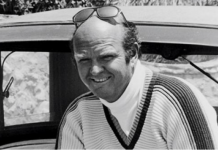
Warren Miller is history’s most prolific and enduring ski filmmaker. Visit warrenmiller.net or visit his Facebook page at facebook.com/warrenmiller.