


The 2014 Winter Olympic Games in Sochi, Russia, are only weeks away with team selections expected by the end of January. Among those vying for spots to compete in the Winter Games are nearly two dozen Tahoe and Truckee area athletes..
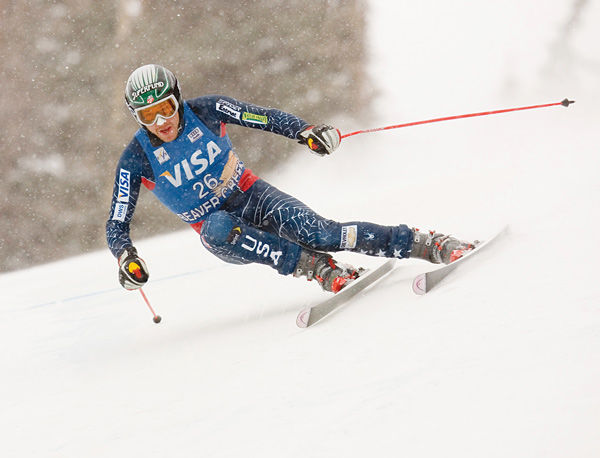
Olympic sport: Alpine skiing, downhill & Super G
Hometown: Tahoe City
Resort team: Squaw Valley
Two-time Olympic downhiller Marco Sullivan is feeling pretty optimistic about his chances of making the 2014 Olympic team. But just 18 months ago, things weren’t looking quite so rosy.
When you’re flying down an icy slope at upwards of 80 mph, a tiny mistake can have great consequences. At 33, Sullivan has been ski racing most of his life and has experienced his fair share of consequences. He has had three knee reconstructions, two fractured heels, two separated shoulders, two herniated discs and two concussions. Injuries are the hardest part of his job.
He had been dealing with a back injury since soon after the 2010 Olympic Games, but it was the season-ending concussion he sustained in December 2011 that nearly ended his career. His sponsors dropped him, and the team said he could come along next season, but he would have to pay his own way. He had already been on the U.S. Ski Team for more than a decade, and it looked like retirement was looming.
“I had to make a decision what I wanted to do, and I still wanted to race,” Sullivan said.
Sullivan took steps to heal his body and started raising money. Eventually, Atomic skis and Squaw Valley jumped on board, and he was back on the hill. Sullivan climbed his way up from the bottom and went on to earn a spot as one of the top 15 racers in the world that season.
Well, that was just last year, and if he keeps it up, he could be on his way to Sochi.
Sullivan grew up living in Tahoe City and skiing at Squaw Valley. His uncle was the head of the ski team there, and his dad was a ski patroller. You could say skiing was just in his blood.
He started out buzzing around Squaw with the Mighty Mites. By 15, Sullivan was racing internationally and on the U.S. Ski Team by 18. Three years later, he crossed the Olympic finish line in Salt Lake City with his family, friends and even former school teachers cheering him on. It was the single most memorable moment of his skiing career.
Sullivan returned to the Olympics in 2010, and Sochi could be his third Olympic run.
One thing that he says that he likes about the Olympics is how it puts everyone on an even playing field. In ski racing, repetition creates an advantage. Many racers ski the same courses year after year, learning all the ins and outs, getting better with each and every run. The Olympic course, however, is equally unfamiliar to nearly all the racers. What’s left is pure skill and what Sullivan considers the most important aspect of ski racing: mental strength.
“What it comes down to is the guys who can embrace the fear and throw themselves down the mountain with no reservation,” he said.
Sullivan admits he may not be the most technically correct skier on the course. Growing up at Squaw Valley, he did a lot more freeskiing than running gates. But, he would like to think he’s pretty good at channeling all of his emotions on race day into just one thing: speed.
He has even mastered the Arctic Man, an Alaskan ski/snowmobile team race, which his team has won for three years running. In the race, the skier races down a mountain, is pulled up another mountain by his snowmobile-driving teammate and then skis down the other side. Last year, the entire 5-mile course took him less than 4 minutes.
And while skiing fast may be Sullivan’s job, he isn’t just in it to win it. He says he skis because he loves it. A pair of powder skis can always be found in his quiver, and he enjoys big mountain riding and freeskiing every chance he gets, whether it’s heli-skiing the back country or mobbing with the Mighty Mites at Squaw.
“I think I like skiing because it’s more of a lifestyle than a sport,” Sullivan said. “I love how people live and die by the mountains.”


