


I wasn’t really sure if I should use this recipe or not. I have to be honest and say that I’m not sure what markets sell fiddleheads out here.
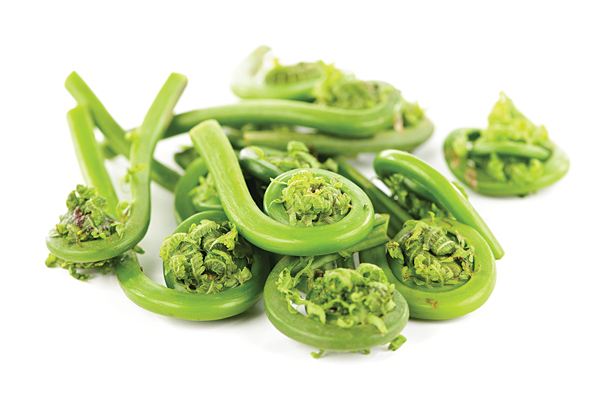
What are fiddleheads? They are baby ferns common back East in wet areas early in the spring just when all the plants start blooming again. We used to go out in the woods and pick them by the hundreds — not picking more than three or four off the same plant — which if I remember right, produces about seven stems.
We used to go out in the woods and pick them by the hundreds — not picking more than three or four off the same plant — which if I remember right, produces about seven stems.
You just have to be careful because there are other ferns that look similar but are uneatable and will probably make you sick. The way to identify a fiddlehead is by its smooth, hairless stem with a pronounced U-shaped groove the length of the stem. I think they grow possibly near some of the Tahoe streams such as in Blackwood Canyon, but I wouldn’t be surprised if they were found down in the foothills, too.
Why are they called fiddleheads? Because when you look at them, they look like the head of a fiddle or violin — the head is all curled with a few of what will become the leaves once the plant opens, at this stage looking more like the screws for the strings.
After you pick them, they must be cleaned before you cook them. There is a brown, paper-like wrapper that must be removed. The wrapper comes off easily, but when you are cleaning hundreds for a hotel or large crowd, it can be tedious. I did get a lot of kudos when I came up with using the dishwasher’s power spray. You can cover the bottom of a dishwasher silverware tray and then the spray will rinse the wrap right off.
As for cooking fiddleheads, there are many ways, but they do need to be cooked thoroughly or they can make you sick. First, you want to rinse them several times until the wash water appears clean and not brown. Next, boil them in lightly salted water, chicken or vegetable stock for 10 minutes, 20 minutes if you are steaming them. After that, you can serve them hot right out of the cooking water with a little bacon or vinegar, put them in soup or follow your favorite recipe.
Bacon goes well with them because they can have a slightly bitter taste much like Brussels sprouts, which the bacon will kind of neutralize.
As a matter of fact, the recipe below is from a good friend of mine in Ohio, whom I worked with for many years at the Memorial Golf Tournament. He recommends white sugar for roasting and brown sugar for bacon. He told me they use this for their Brussels sprouts, but I had to try it on fiddleheads because I find a lot of similarities in the two, flavor-wise.
It was delicious, so if you can’t find any fiddleheads, try this recipe on Brussel sprouts and enjoy.
Roasted Fiddleheads or Brussels Sprouts
1 lb. fiddleheads or Brussels sprouts
3 to 4 C chicken stock
1 T white sugar
4 to 5 slices bacon
¼ C brown sugar
1 to 2 T white balsamic vinegar (or regular balsamic)
Salt & pepper to taste
Cook the bacon in the oven and let cool. Clean the brown wrapper off the fiddleheads and wash thoroughly — or cut the Brussels sprouts in half. Boil in the chicken stock for 10 minutes. If using Brussels sprouts, just a quick blanch will do. Spread them out on a sheet tray, lightly sprinkle with white sugar and roast in the oven at 300 degrees F for 10 minutes or until the sugar is melted and starting to turn golden.
Place the bacon back on a sheet tray; generously sprinkle on the brown sugar and let cook in the oven until the sugar caramelizes, about 10 minutes or so. Let the bacon cool and crumble it up into the fiddleheads. Toss with half the vinegar, adding the rest to taste. Season with salt and pepper as needed.


