


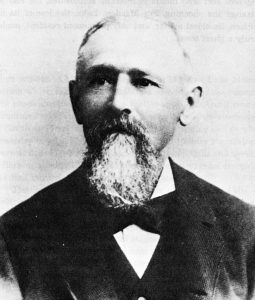
Gold fever was running hot among Sierra prospectors during the summer of 1863, and mining rushes swept the region. News of big gold strikes at Squaw Valley and Martis Valley in 1862 had attracted nearly 3,000 people. Those operations went bust in 1863, but that mining excitement 150 years ago established the first permanent settlers in the Tahoe City area.
Similar to Squaw Valley, a gold discovery at Meadow Lake near Cisco in 1863 inspired a stampede of get rich quick schemers. Henry H. Hartley had built a cabin at the isolated lake among the headwaters of the Yuba River in 1860 to improve his health. For three years, Hartley lived like a hermit. During the long winters he trapped mink, martin, fox and bear, and worked their pelts into valuable furs.
In June 1863, Hartley found rock containing particles of gold. He quickly found partners and formed the Excelsior Mining Company. Word got out about their enterprise, and by 1867 about 6,000 people had invaded the area. There were 600 new buildings, including a church meeting house and fire-resistant brick bank. There were three large hotels and 90 saloons. Painted courtesans lounged in the bars, drinking whiskey and smoking cigars. A small steamer cruised the shallow waters of Meadow Lake, which miners boarded for Saturday night excursions to hurdy-gurdy houses at the upper end.
Despite all the mining activity there was precious little money being made. The ore generated assays of up to $690 per ton, but there seemed to be a problem with the milling process. In fact, pockets of paying gold ore were rare and promising veins quickly pinched out. Legendary Nevada reporters Dan De Quille and Alf Doten were on the scene. Their articles inspired others to join the rush to riches, including attorney Orion Clemens and his brother Sam (Mark Twain). Everyone left when they finally realized that there was no gold, leaving Hartley to consolidate all the Meadow Lake claims into his own single holding.
In 1873, fire destroyed the dilapidated ghost town, except for the house where Hartley still lived. But Henry Hartley’s dream finally came true in November 1891, when a consortium of French investors offered him cash for the mining claims. Ironically, Hartley died unexpectedly while preparing for the journey to Europe. Hartley’s estranged wife Alice soon showed up to claim her husband’s estate. Unfortunately, the worthless mining stocks and $1,500 left by Henry barely covered her debts.
Henry had met Alice in May 1886 while buying supplies at Cisco. Nearly half his age, Alice thought Hartley rich and they married in Sierraville the following year. But after a short time at Meadow Lake, Alice fled to Grass Valley. When Hartley arrived to fetch her home they argued and split up. Hartley returned to Meadow Lake and Alice moved to Virginia City. In September 1893, Alice rented an apartment in Reno’s imposing Bank of Nevada where she offered art lessons. She joined Reno’s social elite and applied for the position of art teacher in the Reno schools.
Murray D. Foley was president of the Bank of Nevada and a Nevada State Senator. A mutual friend introduced Senator Foley and the recently widowed Alice during a railroad excursion to Boca. Thirty-year-old Alice was attractive, well-educated and vivacious. The senator was smitten. Foley learned about Alice’s moribund mines at Meadow Lake and offered to act as broker for the property. He began calling on Alice to discuss a possible transaction of the claim. On the evening of Jan. 13, 1894, Foley arrived unannounced at Alice’s apartment. Alice said that he asked her to join him for a late supper, which she refused. She claimed that Foley secretly drugged her drink, and the next thing she knew, she was in bed with the good senator beside her. Alice refused to see Foley again and had the locks to her studio changed. Despite her precautions, on the evening of Feb. 26, she returned home to find the obsessed senator hiding in her apartment. Once more, he forced her to submit to his will. Alice bought a gun the next day and threatened to shoot the senator if he attacked her again.
In late March, Alice realized that she was pregnant. When she confronted Sen. Foley, he insisted on an abortion. Alice wanted to keep the child and in May she retained a Reno attorney and had him draw up a legal document acknowledging Foley’s paternity and establishing financial responsibility for her and the child. Foley feigned cooperation and the couple did not meet again until July 26 when Alice told him that she was moving to Utah. Foley then admitted that no legal papers had been filed and that she and the child were on their own. A heated argument ensued and Foley grabbed a heavy chair and swung it at Alice, who then fired two shots from her Colt revolver. Mortally wounded, Foley stumbled down the stairs and died.
Eulogies described the murdered senator as a good citizen, but afterwards newspapers acknowledged Foley’s womanizing. Foley’s wife confirmed the charges by refusing to hang black crepe on the family home and she left for San Francisco with her husband’s $250,000 estate.
Alice Hartley’s murder trial lasted several days and was front page news. The prosecution portrayed pregnant Alice as a “dangerous and intriguing woman” with a history of easy virtue. The all-male jury found her guilty of second-degree murder and sentenced her to 11 years in Nevada State Prison. Two months later she gave birth to a baby boy. After serving 18 months of her sentence, Alice and baby were released from prison, but tragically, the child died of scarlet fever seven weeks later. Broken-hearted, Alice moved to San Francisco where she suffered a nervous breakdown. Believing that God had told her to repent, she sometimes interrupted Sunday services by seizing the pulpit to shock the congregation with grim details of Foley’s killing. In her dementia, Alice turned to crime and she was caught stealing jewels in San Francisco. To evade prosecution, she fled to Denver where she fell ill and died on New Year’s Day in 1908.
Through little fault of her own, Alice Hartley is remembered as the only person to kill a sitting Nevada state senator. She was sentenced to prison for murder, but more than 60 prominent Nevada citizens had signed a petition demanding that instead of confinement, the State should have given Alice a gold medal for the deed.
Tahoe historian Mark McLaughlin is a nationally published author and professional speaker. His award-winning books are available at stores or at thestormking.com. Mark may be reached at mark@thestormking.com. Check out his blog tahoenuggets.com.


