


 Visitors to Donner Lake hear all about the historic Donner Party tragedy that occurred there in the winter of 1846-47. Unfortunately, few learn the story of Moses Schallenberger, a remarkable teenage boy who survived the winter of 1845 alone at Donner Lake, 170 years ago.
Born in Ohio in 1826, Moses was the youngest of seven children of Jacob and Barbara Schallenberger, immigrants from Europe. After the Schallenberger parents died of cholera when Moses was 6-years-old, his older sister, Elizabeth, and her husband, Dr. John Townsend, took the toddler into their care and raised him as their own. The Townsends moved several times until they reached Missouri frontier country in 1841.
Read Part II: Moses Schallenberger | Alone at Donner Lake, Part II
By 1844, Dr. Townsend decided to move his family one more time. He thought California’s climate would benefit Elizabeth, so they sold the farm, packed their wagon, and headed to Council Bluffs, Mo., with 17-year-old Moses in tow. The physician also had a professional purpose for heading West — he intended to become the first medically trained doctor in California.
Moses and the Townsends were members of the Stephens-Townsend-Murphy Party, a small group of 50 pioneers that consisted of 23 men, eight women, 15 children and 11 wagons. The company organized at Council Bluffs in the spring of 1844. Nearly half of the emigrants were members of Martin Murphy Sr.’s Irish Catholic family, who were traveling to the Mexican province of California where serious disease was considered rare and Catholicism was the national religion.
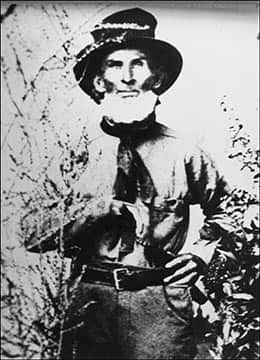
The pioneers elected 40-year-old blacksmith and former mountain trapper Elisha Stephens as their captain. Active, quick and untiring, Stephens was a born leader. He never wore a coat so that all could see his sharp hunting knife, sheathed on his wide belt. He was tall with piercing eyes, and exuded confidence and authority. His quiet, conservative temperament offset fears of rash or arrogant behavior.
Stephen’s leadership qualities were essential to the success of this effort to bring wagons over the Sierra into the Sacramento Valley of California. Earlier attempts had all failed. There were 40 wagons heading West that year, most to the Willamette Valley in the Oregon Country, but the 11 wagons in the Stephens-led outfit were heading for California.
On May 22, 1844, the group started their long journey. They made good time fording rivers and traversing the vast prairie before using the relatively easy grade at South Pass to cross the Rocky Mountains. Caleb Greenwood, an 80-year-old mountain man, along with his two half-Indian sons had been hired as guides to assist Stephens with following the trail and communication with Indians.
For the first portion of the trip, all 40 wagons followed the Oregon Trail until Fort Hall on the Snake River. At that point, the Stephens Party turned southwest toward the Mary’s River (later renamed Humboldt), following wheel traces left by emigrant guide Joseph Walker’s wagons the previous year.
For six weeks, they followed the westward-running river, using its precious water and grass to sustain their oxen and themselves. Caleb Greenwood did not understand the language of the indigenous Indians that inhabited the region, but he communicated through signs drawn in the sand. The emigrants considered the Native Americans they met “poor and degraded,” but the Indians were friendly and every night hundreds visited camp. The pioneers made sure to keep a close eye on their livestock, weapons and blankets when the curious Indians crowded around.
There is no lake at the end of the Humboldt River, only a dry depression in the arid landscape known as a sink. A barren desert 40 miles wide stretches to the horizon west of the Humboldt Sink. No wagons had ever crossed it. To avoid it, Joseph Walker’s group had struck out south, eventually abandoning their wagons.
The Stephens Party was split on what course of action to take. It was early October and time was getting short. The first storms of winter were not far off. After a stressful delay of several days, a friendly Paiute Indian Chief they called Truckee entered camp. Chief Truckee used sign language and diagrams to show Greenwood and Stephens that on the other side of the desert was a tree-lined river filled with fish. Skeptical at first, the pristine, rushing river they found now bears the helpful chief’s name.
The company crossed the desert and later the Truckee Meadows (Reno) in less than a week, and then forced their oxen-drawn wagons up the steep Truckee River Canyon. The precipitous cliffs of the canyon often forced them to march in the riverbed. Constant immersion in the cold river water softened the oxen’s hooves, causing them to split painfully. Nonetheless, the bawling cattle were forced ahead. To stop now meant terrible death in the winter snow. Increasing snow flurries attested to that.
In early November, they reached the picturesque lake now called Donner. Dark clouds cloaked the rugged mountain peaks and a foot of fresh snow already whitened the towering walls of granite. Winter was coming fast.
Despite the urgency to cross the pass, Capt. Stephens was forced to spend several days exploring the treacherous cliffs, searching for a way over. While the main group waited for Stephens to find a suitable route, an advance party was sent ahead on horseback to follow the Truckee River to its source. On Nov. 16, this group reached the north shore of Lake Tahoe and became the first Anglos to stand on the banks of Big Blue. Topographical engineer John C. Fremont had “discovered” Lake Tahoe on Valentine’s Day 1844, nine months before.
Failing to find a better pass for the wagons, this group rode over the Sierra and down to Sutter’s Fort (Sacramento). Meanwhile, back at Donner Lake, Stephens had found a small gap in the cliffs and had given the order to move out. Lacking time and manpower, the pioneers took five loaded wagons and left six at the lake. The men dismantled the wagons while the women and children carried gear and supplies to the summit. Piece by piece, the wagons were pushed, pulled and dragged up the sheer granite walls. It was torture for man and beast.
By Nov. 25, all five wagons had been hauled over the pass, but three men, including Moses Schallenberger, volunteered to stay behind to watch the remaining wagons. They didn’t expect to be there long.


