


Last summer I noticed that a beaver dam had been constructed across the Truckee River above the River Ranch rapids (visit TheTahoeWeekly.com for the story). While much of the river downstream of Fanny Bridge was just bare dirt or shallow mucky pools, the dam had created a deep pool for about a half mile upstream. It was the only place for fish to congregate until the rain and snows returned and water started flowing into the river again.
I was fascinated by the power of the beaver and decided to find out more about it. I was quickly told that the person to talk to was Sherry Guzzi from the Sierra Wildlife Coalition.
While Guzzi has always been a nature lover, it was the killing of a family of beavers on Kings Beach’s Griff Creek in 2010 that made her start the Sierra Wildlife Coalition. Since that time, the group has been both educating government agencies and the public on the benefits provided by beavers, and doing the hands-on work needed to allow beavers and humans to coexist.
[blockquote3]
“You can mitigate any problems caused by beavers. It’s easy to protect trees with adequate fencing and sand mixed with non-toxic paint to match the color of the tree,”
[/blockquote3]
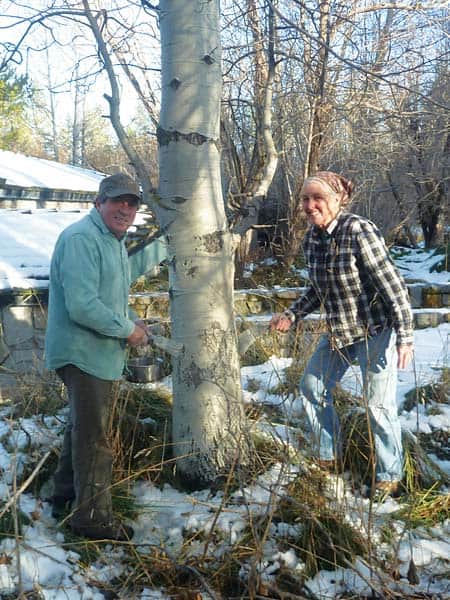
Calling Guzzi’s organization a Coalition is a slight exaggeration. Mostly it’s her and her husband, Ted, working on a shoestring budget out of their house in Cedar Flat. She researched efforts in other parts of the country that have been effective in successfully living with beavers, and set to work trying to convince the local landowners that those same techniques could be done here. Then once she got the go ahead, she gathered a few key volunteers and went to work.
“You can mitigate any problems caused by beavers. It’s easy to protect trees with adequate fencing and sand mixed with non-toxic paint to match the color of the tree,” said Guzzi.
Read more
The other major problem caused by beavers is flooding, and that, too, can be mitigated with the use of pond levelers, which is a flexible pipe installed through the dam to release water and keep the dam below a certain level. They have painted a lot of trees and installed a number of pond levelers at Taylor Creek, Tahoe Vista, Tahoe Donner and other locations.
Beavers live in strong family units and are excellent swimmers, but are awkward and vulnerable on land. They build dams and ponds to protect themselves from predators and to provide easy access to their food sources – inner bark, twigs, leaves and roots of various plants especially aspen, willow, cattails and lilies. They are native to the Sierra, although at one point it was believed they were introduced.
“Beavers do a lot of good for other animals, everyone needs water,” said Guzzi.
Around the Tahoe region especially, beaver dams are an important asset for the environment. They filter water before it gets to the lake, helping to keep the lake clean, and by holding back water during the wet times they insure there will be more water around later in the summer.
Guzzi was raised in Santa Barbara and spent a lot of time working and playing in Yosemite after obtaining her degree in architecture from UC Berkeley in 1971. It was in Yosemite that she met Ted, who was on the maintenance crew. He was just one of her friends at the park until many years later when they ran into each other again in Tahoe.
Sherry made her way to Tahoe because Jackson Hole, Wyo., “was too damn cold,” she says. She wanted to live in the mountains, but after spending time with her sister in Jackson, she decided she needed to find a mountain locale that was warmer. Some people she met extolled the virtues of Tahoe and she made her way here.
Guzzi’s first job at Tahoe was as an architect for Chip Matchum and later Dave Shelton before striking out on her own in 1983, the same year that she married Ted. She specializes in designing log homes, and Ted, who is a builder, has built quite a few of her designs over the years. Sherry says she identifies with beavers because, “we are both vegetarian architects.”
The Sierra Wildlife Coalition started with donations from the Worth a Dam organization and the Wylie Animal Rescue Foundation. It’s a small-scale organization and the Guzzi’s spent more than $400 of their own money on the effort last year. The money goes to pay for paint and sand for the trees and supplies to install and maintain the levelers, as well as the cost of printing brochures used to educate the public.
Anyone who would like to help either by giving a donation or by volunteering may go to sierrawildlife.org or the Sierra Wildlife Coalition Facebook page for more information.


