


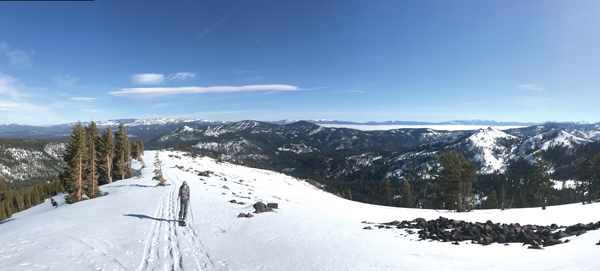
Meet the person leading the drive to preserve access to human-powered back-country winter recreation.
As off-piste skiing and snowboarding grows increasingly popular in the Tahoe Sierra, Tahoe Backcountry Alliance skins and shreds the frontlines working to expand trailhead access while simultaneously minimizing impact. The newest executive director, Anthony Cupaiuolo, was hired in November.
Cupaiuolo grew up in New York and first moved to Lake Tahoe post-college when he worked as a snowboard instructor at Heavenly during the big El Niño winter of 1997-98. After attending grad school for political management in Washington D.C., he relocated to San Francisco for a job.
“I didn’t even last a year,” he says. “I was coming up to Tahoe all the time. For an East Coast kid, it was truly mind expanding.”
TO READ THE COMPLETE 1st TAHOE SIERRA BACK-COUNTRY GUIDE, PLEASE SEE THE DIGITAL EDITION.
In 2001, Cupaiuolo moved to South Shore and started a media company, First Tracks Productions, to produce snowboard, ski and adventure films. He has created projects for local nonprofits including Tahoe Area Mountain Bike Association, National Forests Foundation and Tahoe Rim Trail Association. He is a long-time back-country snowboarder with a keen familiarity of the many winter recreation zones scattered in and around the Tahoe Basin.
“It’s something I cherish and love to do,” he says. “One of the reasons I was given the opportunity to come on board is because I am from South Shore. So far, most of the projects have been North Shore focused. We want to expand to South Lake and even beyond, out toward Carson Pass and the Highway 88 corridor.”
Back-country use explodes
While back-country winter travel was once a niche activity, it has exploded in popularity since the pandemic, leading to associated issues with parking, litter and user conflict. In partnership with Tahoe Backcountry Ski Patrol, the alliance installed laser counters at Castle Peak and Incline Peak last year to track the number of users. This season, they plan to add Powderhouse Peak on Luther Pass in South Lake. This data is essential to apply for grants and other funding opportunities and to get a clear picture of exactly how many people are using the trailheads in winter months.
“If you are accessing a back-country zone in a neighborhood in the morning, you have to be quiet. Leave No Trace is also important and that includes dog poop. It leads to negative feedback and potential calls for no parking.”
–Anthony Cupaiuolo
The counters reported 13,386 users at Castle Peak from December 2020 to April 2021, with 2,327 users at Incline Peak during the same time frame.
After seeing the unsurprisingly formidable data for Castle Peak on Donner Summit, the alliance partnered with Truckee Trails Foundation to adopt the trailhead and organize cleanups.
“In many ways, [increased use] is a good thing,” Cupaiuolo says. “At the same time, it’s led to some problems. Sometimes there’s not parking where you want to have parking. People need to be mindful of Leave No Trace principles. There are occasional conflicts in large part because we’ve got more users and more people who are coming up here.”
Increased parking access
While some may take entry to wild lands for granted, there is a lot of headwork that goes into achieving and maintaining sustainable access throughout the patchwork of public and private lands dotting the region.
Last season, in an effort to mitigate the impacts of the popular and historic Donner Lake Run that descends from Donner Summit to Donner Lake, the alliance spent more than $30,000 to repave and plow one half of the parking lot at West End Beach.
“As it turned out, it wasn’t quite enough because a lot of people were using it for snow play,” says Cupaiuolo. “From our prospective, it’s great. We don’t look out only for the back-country user. We were able to get an agreement with Visit Truckee Tahoe to plow the rest of the lot this year. Now, there’s more room for everyone.”
The alliance also plans to install additional signage along the main run from the backside of Sugar Bowl Resort to the exit corridor on Cottonwood Street in a nearby neighborhood. The signs include a QR code, which provides back-country travelers with a map and boundaries for the run. The intent is to avoid travel through private property and alleviate conflicts with residents and other land holders in the area. So far, no neighbors have made any formal complaints to the Town of Truckee or Nevada County on the project, says Cupaiuolo.
The alliance is now looking into a new parking possibility in South Shore at a large lot at the intersection of Elks Club Drive and Highway 50. Owned by Tahoe Conservancy, it is a popular place from which to float the Upper Truckee River. However, it’s not plowed in the winter. If it were, it could provide a critical meeting point for back-country users headed south toward Luther and Carson Pass.
“We’re trying to reduce the number of vehicles at trailheads,” says Cupaiuolo. “If we can increase park and ride options, it can help with that.”
Several other popular winter trailheads are also on the alliance’s radar. Parking for one of the basin’s classic back-country tours, Mount Tallac, consists of a few tiny turnouts along Highway 89 and Spring Creek Road that are only sometimes plowed. The current situation can be dangerous with cars precariously crammed along a busy, blind turn.
As part of an upcoming forest-thinning project adjacent to Spring Creek Road’s seasonal gate, there may be a chance for a new winter parking lot. A National Environmental Policy Act study was done on the area, but the Forest Service doesn’t have the budget to create an expanded trailhead.
“Fundraising efforts would take place when projects like this are shovel ready,” he says. “There will be plenty of frustrations. The good part is there is opportunity to get meaningful things done.”
Trailhead parking guidelines
Courtesy Tahoe Backcountry Alliance
- Roadside parking is illegal & may result in ticketing and/or towing.
- Park off the road in approved parking areas only.
- Do not park in areas that have not yet been plowed.
- If your preferred destination trailhead is full, please head elsewhere.
- Do not park in homeowners’ driveways regardless of the current occupancy situation.
- Just because other people are parking there doesn’t mean it’s legal.
- Permits are required at California Sno-Park & must be purchased in advance.
- Be courteous.
Respecting private property
Another access point that has long been stressed is the base of Rubicon Peak. The only public trailhead at the top of Highview Drive in Meeks Bay has room for a handful of cars. The alliance paid for a study of what it would take to rebuild the lot. The Tahoe Regional Trails Plan currently being developed by a coalition of Tahoe-Truckee partners could help push the project forward.
“With the highway 400 or 500 feet below the only parking, people are sometimes coming down through private property to get to 89,” says Cupaiuolo. “That’s not something we encourage at all. We want public access to public lands. We don’t want people to have to trespass. The alternative is no access to Rubicon Peak, which is also not feasible. We need partners for this one.”
Access points located in neighborhoods are particularly sensitive to winter traffic. In South Lake, the alliance is monitoring the trailheads to Trimmer Peak at High Meadow Road and to Echo Peak on Wintoon Drive.
“We are making sure plowing is taking place in a timely way and that users are being respectful,” says Cupaiuolo. “If you are accessing a back-country zone in a neighborhood in the morning, you have to be quiet. Leave No Trace is also important and that includes dog poop. It leads to negative feedback and potential calls for no parking. I think a lot of people do get it, but not everyone. Sometimes there is an educational component for the people who live there, too. It can go both ways.”
In short, it really all comes down to respect.
“How would you want your backyard to be treated if people were coming to where you live to access skiing, biking and everything like that?” Cupaiuolo asks. “There should be no showing up with three buddies in three different vehicles. Don’t block mailboxes, etcetera. Park head in if you can.”
Back-country shuttle returns
This winter, the alliance will revive its micro-transit program to provide shared rides for four to six skiers at a time. The free shuttle paid for by the alliance is available on 16 Saturdays and Sundays through April 2. Users should contact Tahoe Sierra Transportation directly by phone at (530) 550-5300 to make reservations.
“It’s not the solution, but it’s a component of how we make things better,” says Cupaiuolo. “We need to limit impact at these trailheads. It allows people to access crowded locations or do point-to-point travel.”
At the end of the day, a big part of the alliance’s mission simply involves spreading the good word about back-country sustainability and ethics. They have posted a Backcountry Tips and Etiquette guide on their website along with a link to Report an Access Issue. Last month, they raised more than $4,000 from a well-attended film and raffle event at Alibi Ale Works in Truckee.
“It gives us a chance to chat with people,” says Cupaiuolo. “That includes people at trailheads and out on the skin track. We need to bring things up politely if we want to see change in some negative behavior that happens in some zones. If you see something that isn’t cool and keep it to yourself, that doesn’t work.” | tahoebackcountryalliance.org
Resources
- AIARE courses | avtraining.org
- Avalanche information & education | avalanche.org
- Back-country shuttle | (530) 550-5300
- Sierra Avalanche Training Center | sierraavalanchecenter.org
- Sno-Park Permits | (916) 324-1222, ohv.parks.ca.gov
- Tahoe Backcountry Alliance | tahoebackcountryalliance.org
- Take Care Tahoe back-country safety | takecaretahoe.org/backcountry


